


When Volkswagen launched their latest Crafter in 2017, Volkswagens first aim was for it to sell better than the first Crafter. In order to ensure this, they wanted to cover every base when it came to customers requirements. So, the latest Crafter is offered in front-wheel drive, rear-wheel drive & 4Motion all-wheel-drive with a range of three versions of the same 2.0-litre TDI engine, offering power outputs of 100bhp, 138bhp & 175bhp. The 100bhp unit delivers torque of 300Nm between 1,400 & 2,250rpm, the 138bhp option has 340Nm from 1,600rpm to 2,250rpm, with the range-topping BiTurbo unit offering 410Nm between 1,500 & 2,000rpm. It’s also available as single or double cab with varying lengths, with or without conversions solutions, including dropsides & tippers (ex-factory). It also has a maximum gross vehicle weight (GVW) of 5.5 tonnes.
The Crafter CR50 Trendline MWB 2.0 TDI 177PS 6sp manual RWD mode, with a GVW of 5 tonnes, made it’s way up to Company Car & Van Towers for us to drive. Having already driven the 3.5t version, it was interesting to see how different the larger RWD version would be & in all honesty, after a week behind the wheel, it was just as good !

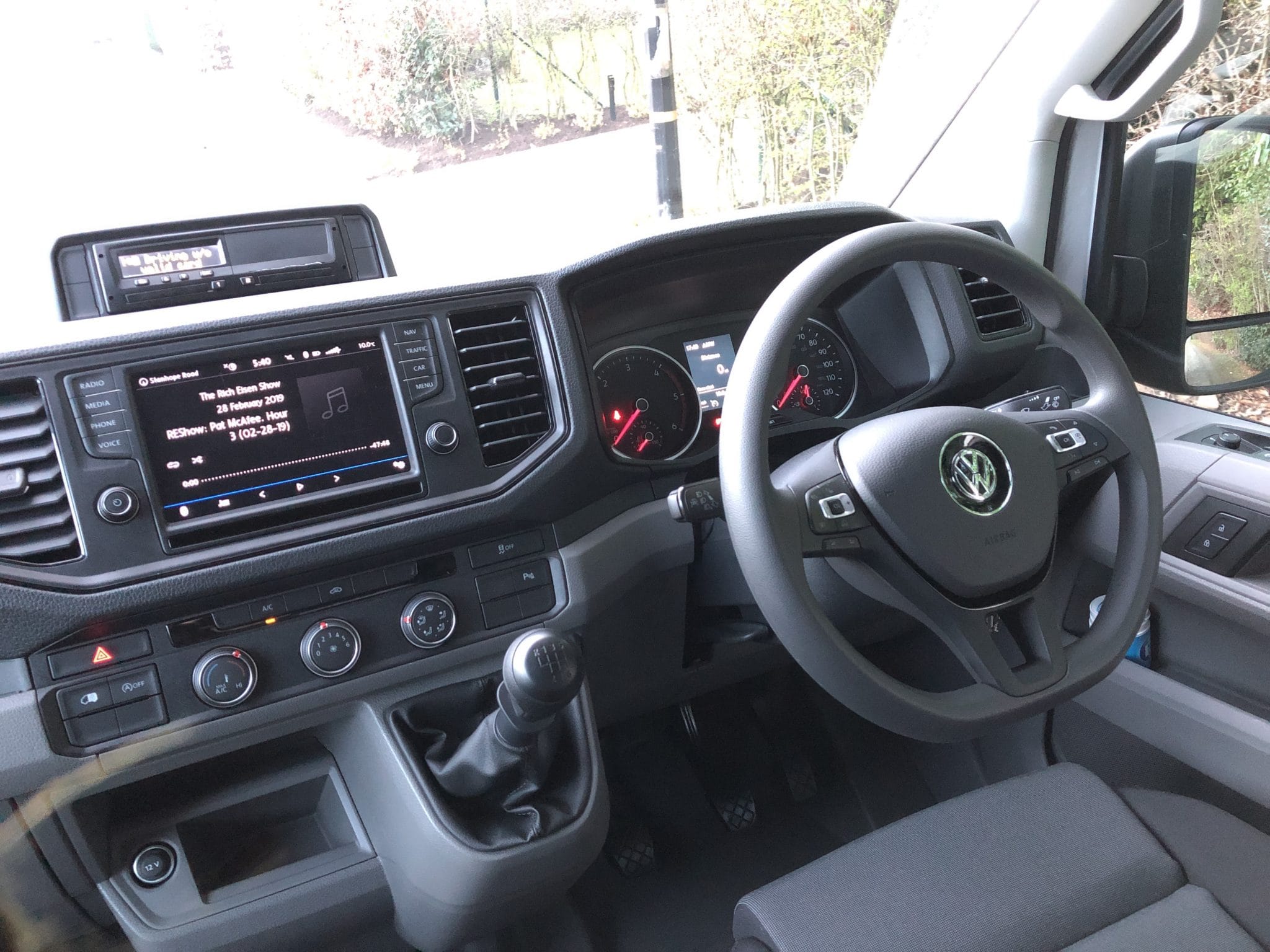
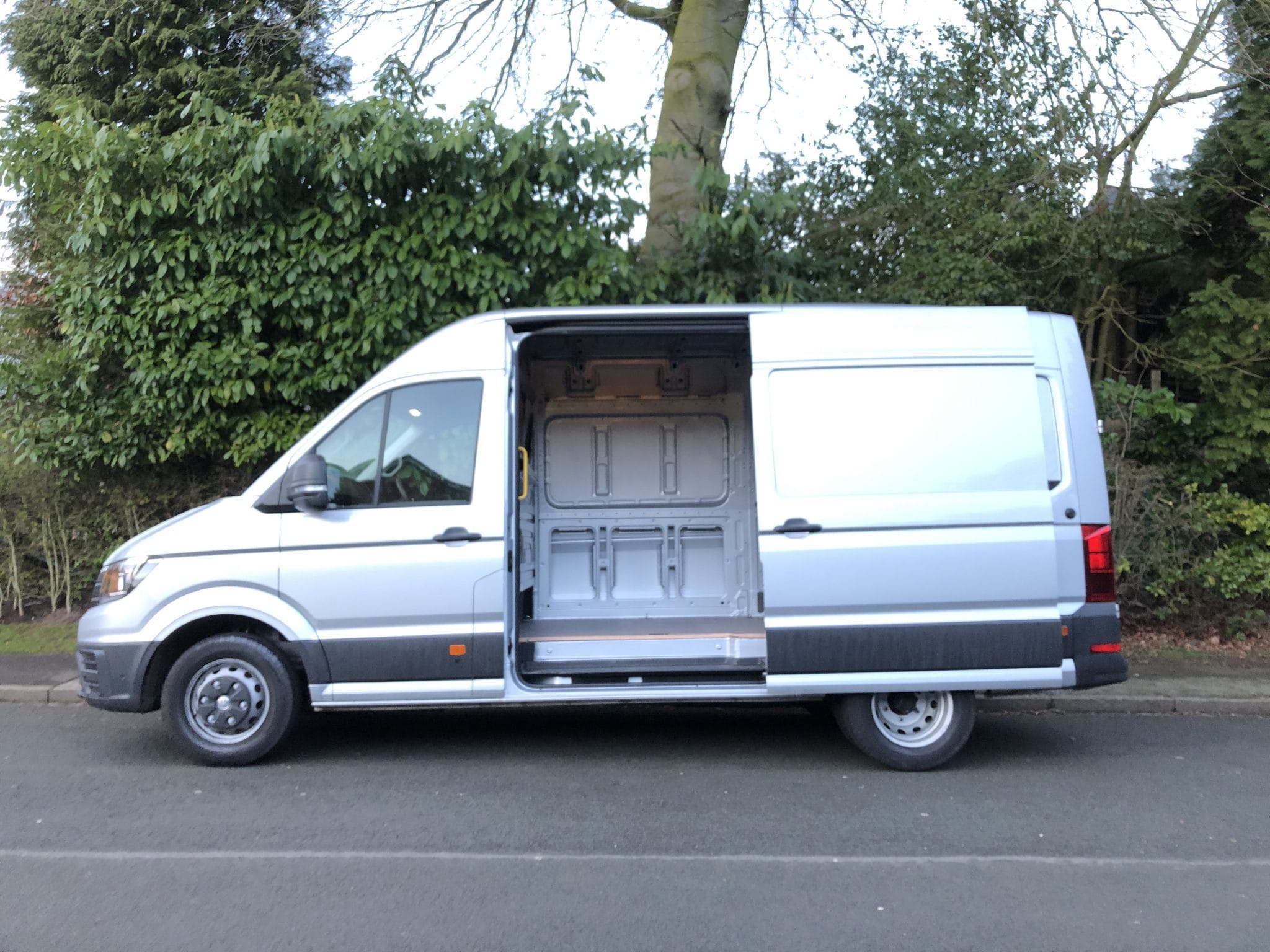
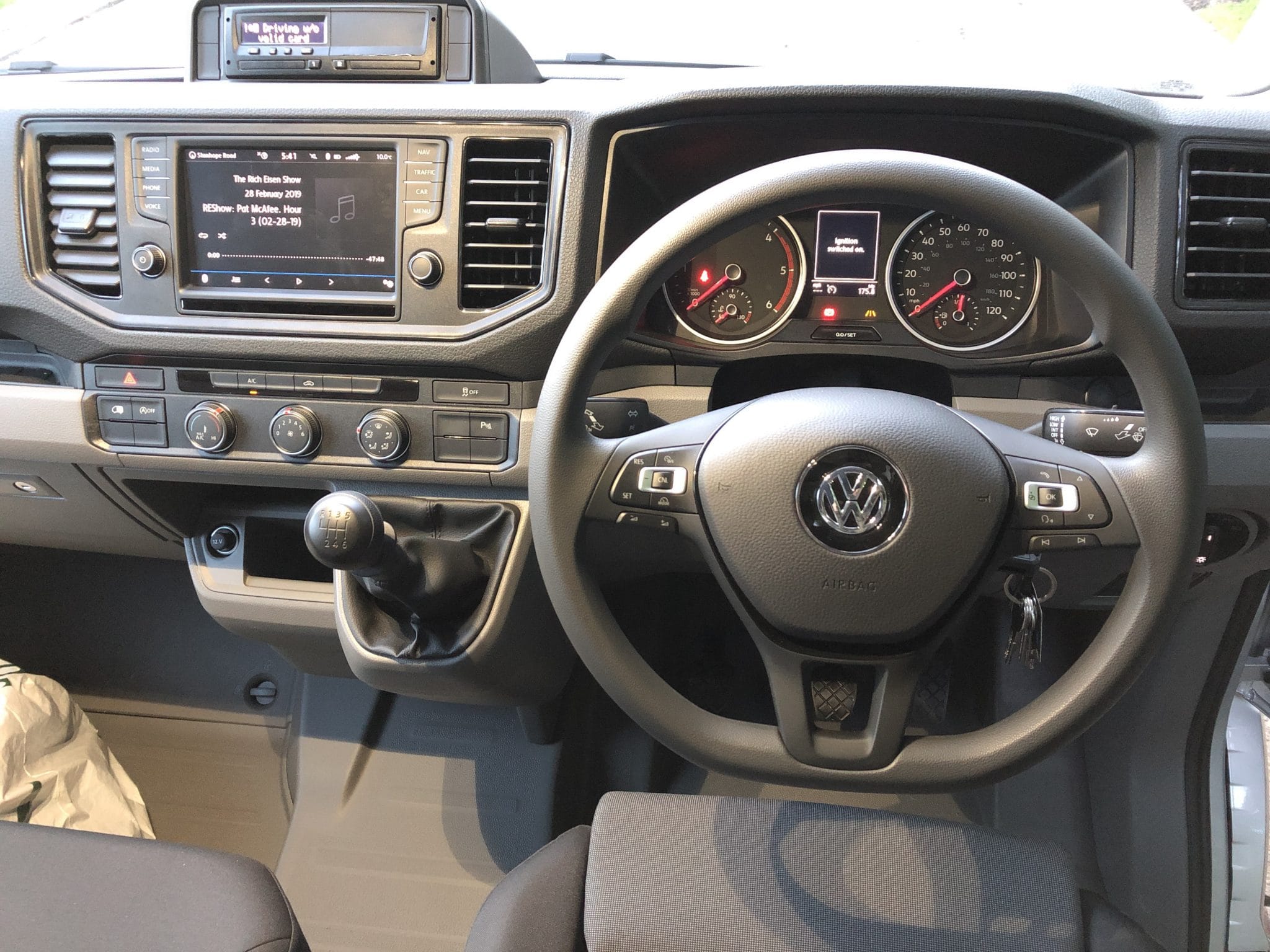
First things first. The Crafter in any size, looks fantastic & is much more in keeping with the Volkswagen passenger car look, especially inside. At the front there’s large wrap-around headlights & a Volkswagen-branded slimline chrome-trimmed grille. The sides have two neat fold’s in them giving the van an aero-dynamic look & at the back, the large VW logo coupled with large rear light clusters, really finish s the look off. Inside, the Crafter offers the nicest van interior I have this far experienced, even more so than there latest Sprinter, coming as it does with a car-like ambience to it. The driving position is excellent. Both the switchgear & steering wheel are borrowed from Volkswagen’s car range & the quality of the plastics & finishes rival its cars as well. The instruments are also very much along the line found in VW cars, with the highlight being the 8” touchscreen that sits in the centre of the dash.
For those of you who like your cabin storage, you’l be pleased to know that the Crafter is generous. There are two door pockets in each door, an array of dash-top cubbies with a USB connection plus two 12-volt power supply’s. There are a number of cup holders, a decent-sized glovebox & on our test model the addition of overhead storage above all three front seats, adds even more useful space.
The central passenger seat can be folded down to create a desk, with both front passenger seats turning over to offer even more storage space underneath them. The full steel bulkhead keeps the cabin warm as well as quiet. All three front passenger get great head & legroom, with the drivers seat offering plenty of adjustment.
Equipment levels are excellent. Standard safety kit on all models includes four airbags, ESP stability control, Automatic Post-Collision Braking System & side-wind assist. Our test model ran on 16″ steel wheels & comes with cruise control with limiter, driver alert system, Stop/Start,rubber floor covering in there cab, a manual side sliding passenger side door, hill start assist, remote control centre blocking& wooden load floor covering. Add ons included a telematics Car-Net security & service system £294, a rear -view camera £270, a rear step in the bumper £246, Discover Media navigation system with 8″ touchscreen £876, metallic paint £1338 & a driver assistance pack including front & rear parking sensors £1002. The OTR price for our test van was £45,232 & with add on’s this went up to £51,382 OTR including vat.
All of the Volkswagen Crafter’s engines are 2.0-litre units from VW’s EA 288 family of commercial vehicle units, develop dot offer low down pulling power as well as fuel efficiency. All are Euro6 compliant, & feature common-rail injection engines fitted with an advanced SCR catalytic convertor system to clean the exhaust gases. A stop-start system is also fitted as standard, with VW claiming a 15% improvement in fuel economy over the previous Crafter, whilst Volkswagen claims class-leading aerodynamics of 0.33 Cd.
The 6-speed manual model we tested, with the 177PS engine returns a claimed 32.5mpg on the combined cycle with CO2 emissions of 228g/km. Volkswagen has also reduced running costs through extended service intervals compared to the old Crafter. There’s one less oil-change needed in the first 200,000km than before along with other measures to make the services that are required more affordable.

Although the 5 tonne MWB Crafter is a large van, when you start it up & drive off, it doesn’t feel so. Yes, it’s quite obviously a large van & has to be driven thus, but around town & in my local neighbourhood it’s so easy to drive it never feels big on the road. This is partly due to the fitting of the electromechanical steering system in the Crafter, which was a first for the large panel van class. This basically adjusts the steerings weight, according to the van’s speed. The easy to reach six-speed gear stick is neat & slick to work & the overall feeling driving the new Crafter is incredibly relaxing, far more so than other vans of this size.
The infotainment system shames many £30,000 cars for ease of use & quality. The SatNav is excellent, the DAB radio easy to navigate & the Bluetooth system connects quickly with the steering wheel controls enabling hands-free calls to be made safely.
Large vans need to offer decent storage. The Crafter has been designed to maximise carrying capacity & the new expanded range gives it a wider variety of body sizes than before. There are three vehicle lengths, starting with our 5,986mm ‘mid-length’ model, then the long wheelbase version at 6,836mm, plus there’s the ‘long-wheelbase plus overhang’ version, with an extended rear overhang, taking total length to 7,391mm. On top of that are a trio of roof heights, with the maximum cargo capacity on offer now being 18.4m3. Front-wheel drive variants have gross vehicle weights of between 3 & 4 tonnes. The rear-wheel drive models offer gross vehicle weights between 3.5 and 5.5 tonnes & the 4Motion 4×4 Crafters offer the carrying of weights up to 4 tonnes.
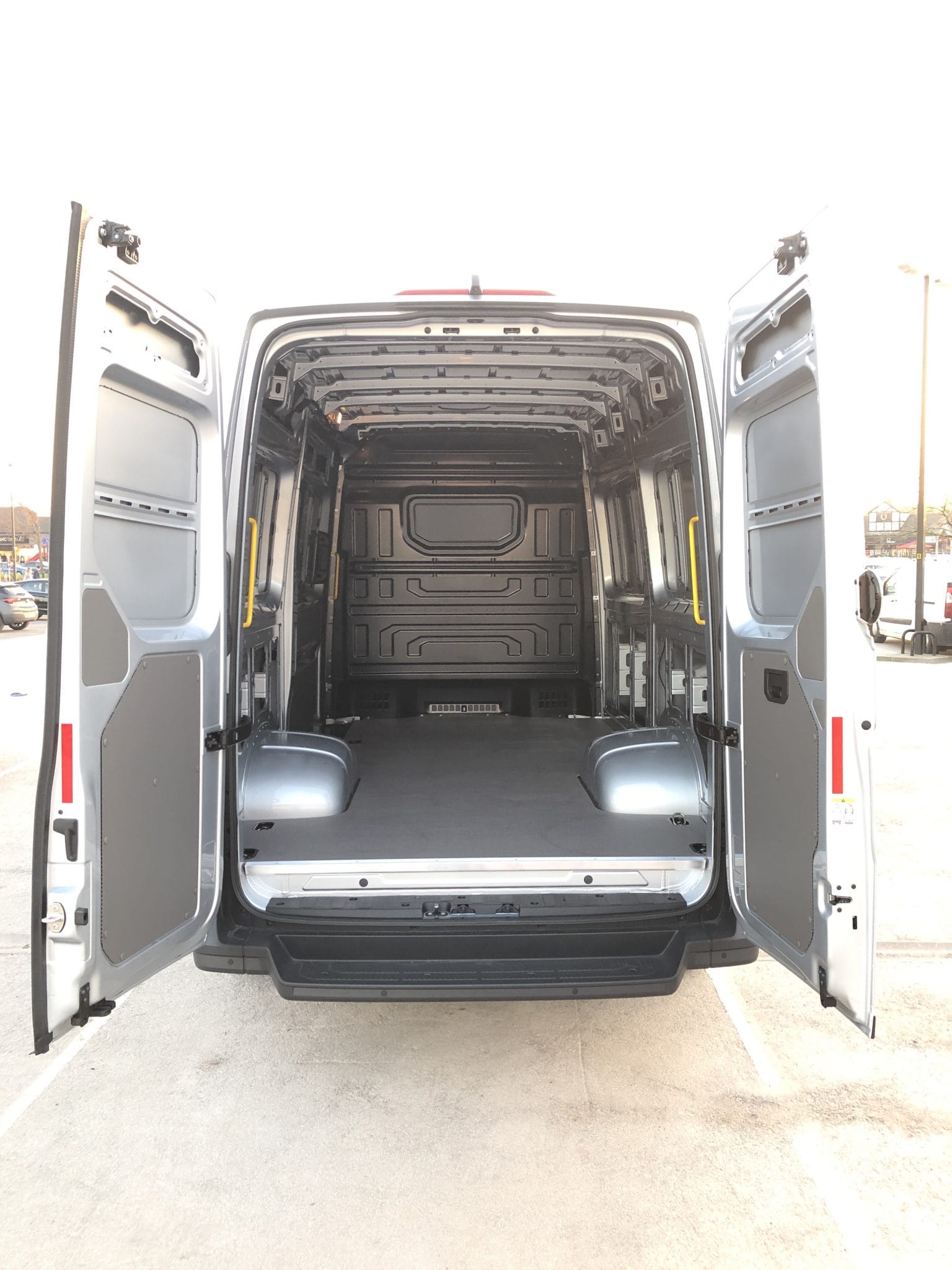
Our test model offered a payload of 5t, a capacity of 14.4 cubic metres & measures 5,986mm long by 2,427mm wide by 2,590 mm high. The rear doors open up to 270 degrees & the side door has a 1,311mm opening. Our MWB test model offers space for six Euro pallets, whilst the load bay itself is lined with rigging tracks giving a host of different options for securing cargo. I used the Crafter to transport three old wooden window frame’s to my local recycling centre, each measuring 1.2 m high x 1.5 m wide & they fitted in the back very, very easily. In fact, I could have easily fitted three more. A wide range of options is also available, designed to tailor the panel van loadbay for different needs. A wooden floor with integrated shelving mounts that allow the installation of existing racking systems is offered, along with an interior roof rack & storage boxes over the wheel arches.
Out on the road, the Crafter really is a joy to drive, although beware a largish turning circle. You may need that reversing camera ! Despite our test model being limited to 55mph, meaning we spent some fun motorway miles overtaking & being overtaken by slow lorries, it’s clearly a comfortable motorway performer, although I would have loved to have gone quicker. On the up side, in our week of 250 miles in the Crafter we returned an average of 30.2mpg,so every slow motorway drive has a silver lining.

With the latest Mercedes-Benz Sprinter, the Crafter now faces stiffer competition in its sector than ever before. Alongside sister model the MAN TGE, it and the Sprinter are at the top-end of the large van sector, offering class leading comfort, driver tech and safety.
The only down side is that all of this doesn’t come cheap, so if you’re shopping on price & not quality you may want to look elsewhere. If I had to spend a long day in a large panel van, the Crafter is definitely high on my list.
A long-haul 4/5
