


Hyundai’s Tucson is their best selling car in the UK & whilst the IONIQ models are the brands EV range, many company cat drivers prefer a plug-in, which still offers them low BIK. We took to the streets in the Tucson plug-in to find out more.
 What’s new & prices ?
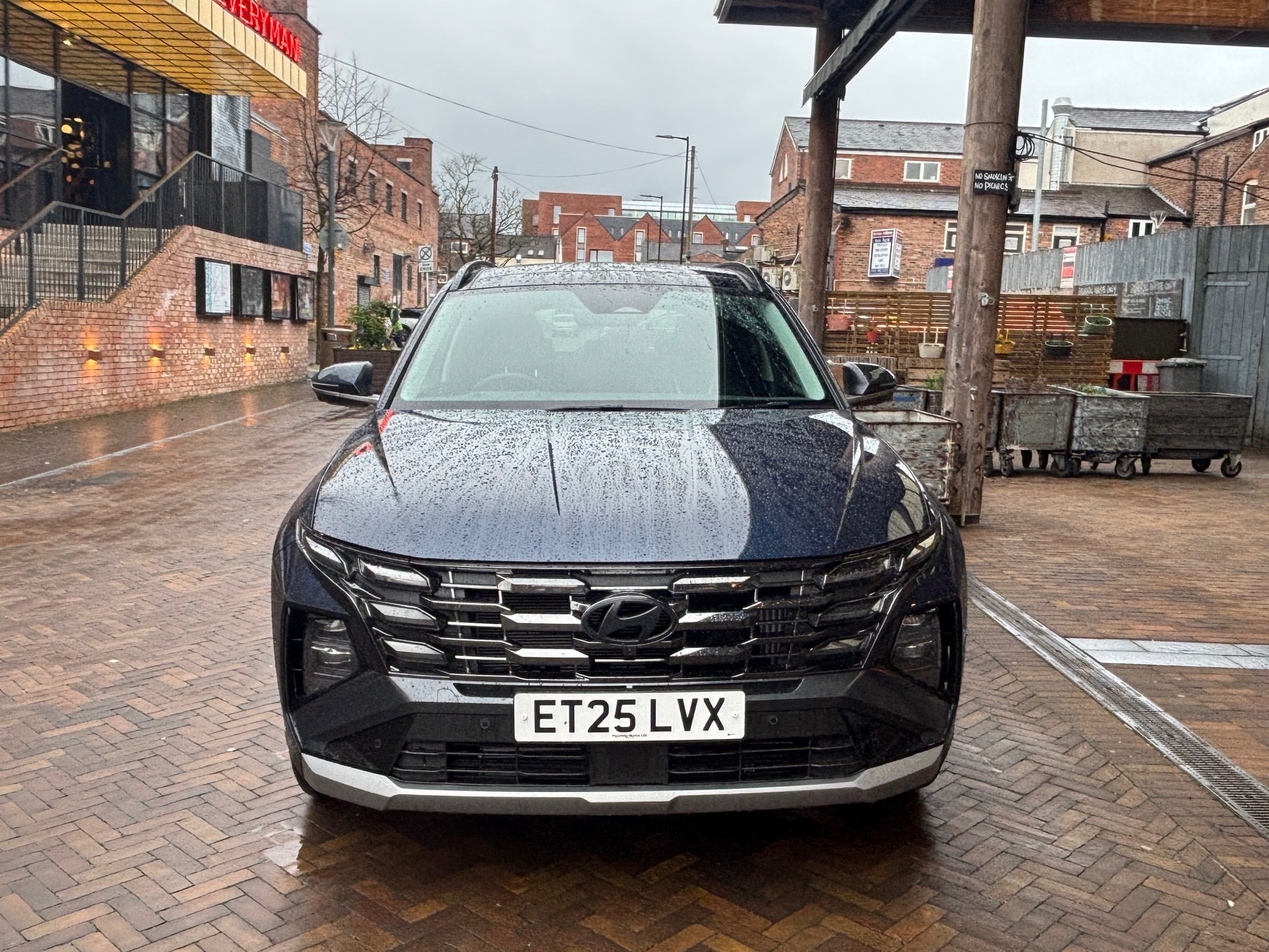
A squared off front grille, larger daytime running lights, resigned bumpers, revised alloys & new skid plates at the front & the rear for starters. Inside the dashboard been updated & simplified in line with the other models in the range. Prices range from £39,410 – for the Advance model going up to £44,410 for the 4WD Ultimate PHEV.
 What is it ?
The Tucson is currently Hyundai’s best selling car in the UK. Launched back in 2004, it competes in the crowded market that is mid-range SUV’s, so is up against the likes of the Nissan Qashqai, KIA Sportage & Volkswagen Tiguan. The latest version offers customers a wide choice of powertrains including the plug-in version we were testing, that features a 1.6 litre T GDi four-cylinder engine. developing 252PS.
 Model range
Choose from Advance, Premium , N Line, N-Line S & Ultimate. Plus four engines. A petrol 1.6-litre T-GDI 4-cylinder, another petrol, a 1.6-litre T-GDI 48V 4-cylinder, a petrol 1.6-litre T-GDI HEV 4-cylinder & our test car the plug-in hybrid petrol 1.6-litre T-GDI PHEV 4-cylinder. The PHEV isn’t offered in Premium trim.
 Engine & performance
We were testing the plug-in hybrid electric version which combines a 1.6-litre GDi four-cylinder turbo petrol engine with a 90bhp electric motor offering 72 kW. There’s also a 2WD plug-in as well. Whilst the power is there, 265Nm’s of torque, it’s almost half a tonne heavier than the standard Tucson hybrid. So, the 0-62mph time of 8.6 seconds is slower than that model.

Electric range, mpg & charging
With a 13.8kWh battery, the Tucson’s electric driving range is 43 miles. Using your home 7kWh charger, the battery takes around 2 hours to charge thanks to it’s 7.2kW on board charger. Our advice as always is to invest in a home charger & plug in whenever you can. We recommend Rolec; http://www.rolecserv.com/home-charging
 Equipment
Entry-level Advance models get 17″ alloys, LED headlights, front & rear parking sensors, ambient lighting, keyless entry, cruise control, front & rear electric windows, parking sensors, wireless phone charger, roof rails, SatNav & traction control. Premium cars gain larger 18″ wheels, scuff plates, leather & cloth seats, heated seats front & back, adaptive cruise control & junction turning warning. N Line cars get 19″ wheels, microsuede & leather trim, rear privacy glass, exterior N Line styling, with N Line S & Ultimate adding LED matrix headlights, electric ventilated heated seats & an electric panoramic sunroof. DAB, Apple CarPlay & Android Auto are also present across the range.
 Interior
Tucson features a panoramic curved display, which combines a 12.3″ digital instrument cluster & a 12.3″ infotainment touchscreen in one seamless unit.
 The cabins nicely put together & features some nice soft touch finishes. Even the plastic located lower down is of good quality. The reduction of features controlled by touch pads & the introduction of short cut buttons beneath the touchscreen, for the climate control , heated seats & steering wheel & parking sensors gets a thumbs up from us.
You change gears via a right hand side steering wheel stalk; Reverse, Neutral & Drive. And from a switch the centre binnacle you can select the cars driving modes as well. Sport or Eco & on our test car the three Terrain modes, Snow, Mud or Sand.
 The infotainment screen graphics are super clear & sharp, with most functions easy to use. Steering wheel controls allow you to check on the cars progress, fuel economy, set cruise control or toggle between the media functions.
 Safety
Hyundai Smart Sense comes with a vast array of features. For parking alone you get Rear Cross-Traffic Collision-Avoidance Assist, Forward/Side/Reverse Parking Distance Warning, Reverse Parking Collision-Avoidance Assist, Rear View Monitor & Surround View Monitor. And don’t forget Intelligent Adaptive Cruise Control, Speed Limit Assist, Lane Follow Assist, Lane Keep Assist, Front, Front Side, Curtain & Centre Front Airbags. Hyundai have a handy short-cut to access the driver safety, a star button within the steering wheel switches which enable you to de-activate the more annoying ones.
 Usability
We added our iPhone wirelessly to utilise AppleCarPlay & Android Auto connectivity is also offered. The large dual-screen tilts slightly towards the driver with Hyundais useful short-cut buttons for functions such as Home, Map, Search, Media, Set-up, directly underneath. The stand-alone digital climate controls are a great addition meaning it’s easy to adjust the temperature whilst on the move. Under this are buttons to access the parking camera, hill descent control, drive & terrain modes & the auto brake hold.
 Practicality
Two central cup holders, a glove box, 2 large door pockets, under armrest storage & a wireless phone pad are located up front. Twin USB’s, separate heating controls & a fold down armrest in the rear.
 The plug-in comes with a decent enough 546 litre boot, only about 70 litres less than the standard petrol version. You also get a handy flat boot floor & space underneath for storing charging cables. If you fold down the rear seats the boot space increases to a very useful 1,730 litres.
 On the road
Although this Tucson is heavy, the battery weight doesn’t really affect the ride. Even over poor road surfaces, the suspension copes well. The electric motor gives excellent throttle response & you’ll find that you can overtake with confidence. Whilst the six-speed automatic gear box makes driving easier, when pushed hard, the engine can become quite noisy, but, it’s much better than Toyota’s CVT transmission.
 We drove along the A68 in County Durham, which is a winding up & down route across the North Pennines. The Tucson handles the road with aplomb. There’s plenty of grip & the precise steering makes short work of the road ahead. There was enough power on offer to safely overtake a tractor when required.
 On the motorway, the plug-in is a comfortable cruiser & by utilising Hyundai Smart Sense & adaptive cruise control, which keeps the car in lane & sets up a safe distance to the vehicle in front, you can let the car do the hard work for you. An added bonus is that there’s little in the way of wind & tyre noise entering the car, so you reach your journeys end relaxed.
Driving modes, regeneration & fuel economy
The driving mode you select, will shape the cars economy too. Choose from Sport or Eco. With an eye on fuel economy, we drove mostly in Eco, including a 200 mile around trip to Warwick. Even in Eco, the Tucson performs admirably & unlike the larger, heavier, Santa Fe fitted with the same power unit, the Tucson’s more fun, lighter & faster as well. And a note too about the brake regeneration which you can activate in Eco mode by pulling the steering wheel paddle up to 3 levels, none of which really decrease the cars fun.
 Overall, after a week of mixed motoring, we returned a very healthy 55.5 mpg, which for us is as good as it gets & around 10mpg better than we have achieved in similar plug-ins. The trick as always with a plug-in hybrid, is to plug-in at home until you’re fully charged. Then utilise the electric range for urban stop-start driving, whilst choosing petrol only for the motorway or similar.
 Pros
Pros
The Tucson PHEV gave us the best plug-in mid range SUV fuel economy we’ve ever had. There’s low BIK on offer across the PHEV range. All models feature great tech & plenty of safety functions. It’s aggressive looks make it stand out from the competition & the new quality user-friendly interior & curved touchscreen is one of the best there is.
 Cons
Cons
The plug-in Tucson, is expensive compared to petrol & self charging versions & also cost more than PHEV’s like the MG HS.
 Conclusion
With a raft of similar plug-in mid-range SUV’s to choose from, we felt that the Tucson PHEV is still one of the best cars in the sector. Not only does it stand out in a crowd, it features on-trend tech, it’s comfortable, spacious & refined on the road as well. Furthermore, all Hyundais come with a five-year warranty & you’ll not want for any safety features either. For company car drivers, the low BIK is a bonus & makes this version the one to choose. On the down size the PHEV is expensive but since most customers will lease then this shouldn’t be an issue.
A Gladiator 2 4.5/5
