


There’s no doubting that Mazda’s designers are on a roll, with the launch of the all-electric MX-30 joining the super-attractive Mazda CX-30 mid-range crossover, which we drove recently.
We were testing the likely best selling 2.0 litre 180ps GT Sport petrol version, which benefits from Mazda’s Skyactiv-X petrol engine. The 2.0-litre unit uses spark-controlled compression ignition & a mild-hybrid setup to reduce emissions, resulting in a pleasingly low 105g/km of CO2’s on our test car. Skyactiv-X also has the benefit of appealing to both corporate customers & retail folk alike.

It’s good to know what all CX-30 models come decently equipment. Entry level SE-L is fitted with 16″ alloys, LED headlights, a head-up display, rear parking sensors & an 8.8″ infotainment system, that includes SatNav & smartphone integration. The SE-L Lux comes next & adds a reversing camera, front parking sensors & keyless entry, while the mid-range specced Sport Lux, add’s 18′ alloys & a manual sunroof.
We were testing the GT Sport version, which is further enhanced by leather seat trim, a powered drivers seat, a heated steering wheel, door mirror tilt down function when reversing & the 12-speaker Bose surround sound system, with Bose CenterPoint, BassMatch & AudioPilot technology. Above this, sits the GT Sport Tech, which adds on extra safety features, including a 360-degree camera & front cross-traffic alert.
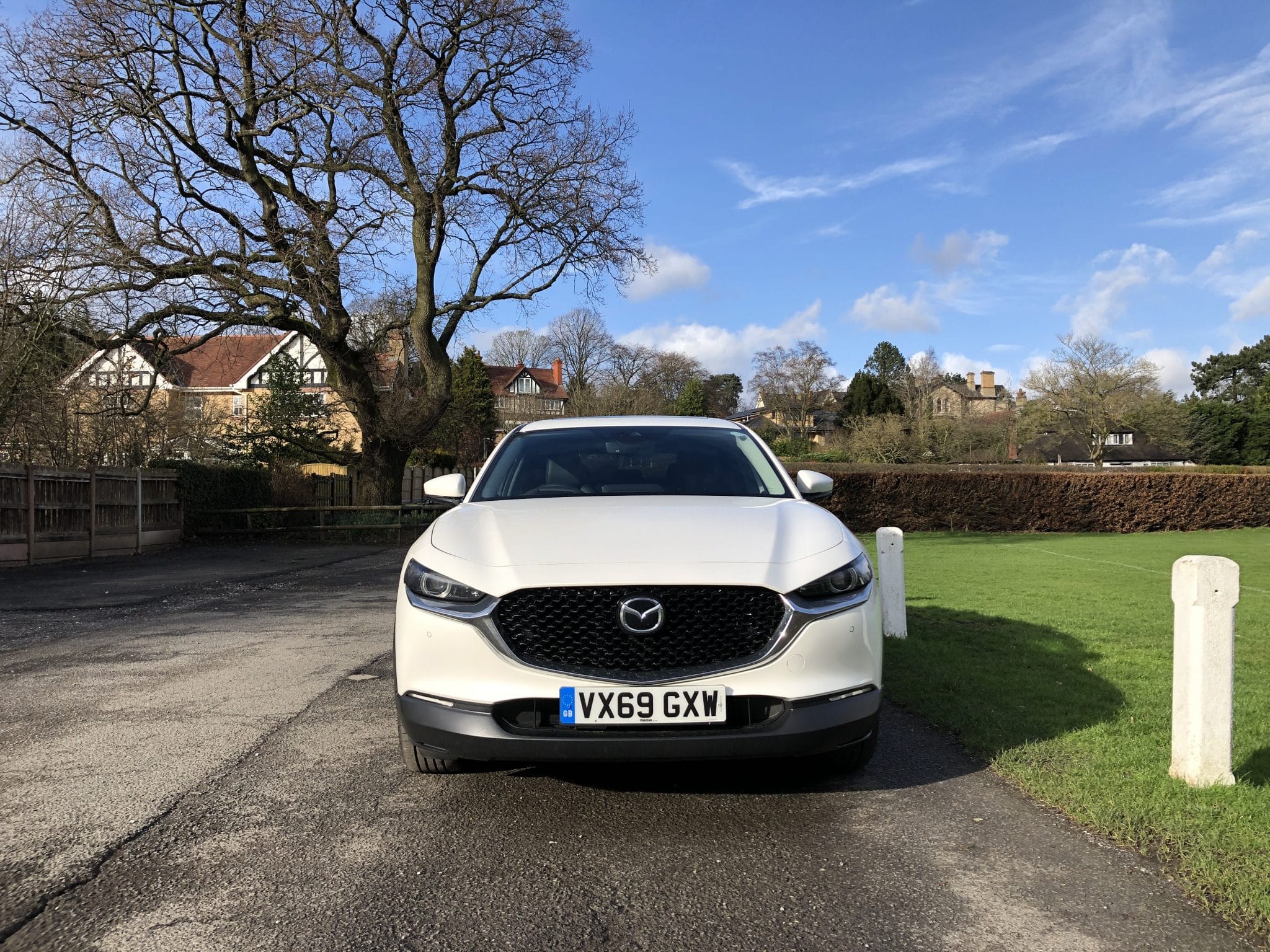
If you stare long & hard at the CX-30 it looks well, just like the CX-3 only slightly larger. Like it’s smaller sibling, it’s narrow front LED headlights, give this mid-range crossover a sporty look. At the back, the slim tail-lights have the same effect. They’re shallow & wide, sitting across the rear wings & hatchback. As with the other Mazda crossover’s, there’s lots of black plastic body cladding around the wheel arches & door sills, which are designed both to give the car a rugged appearance & to protect the bodywork from minor scrapes. From the side the CX-30 forms a neat aero-dynamic wedge shape.
Inside, the minimalist dashboard has been designed to enable one to easily reach all of the switches & buttons located on it. It is pretty much identical to the layout in the Mazda3, with a dash top mounted infotainment system controlled by a rotary dial located between the two front seats. The system graphics are excellent, particularly those used in the SatNav & are a real improvement over the old Mazda system. You can connect your smart phone to either Apple CarPlay or Android Auto using the USB connection. Furthermore, the screen is bright & clear & again, changing functions can be selected using the rotary dial.
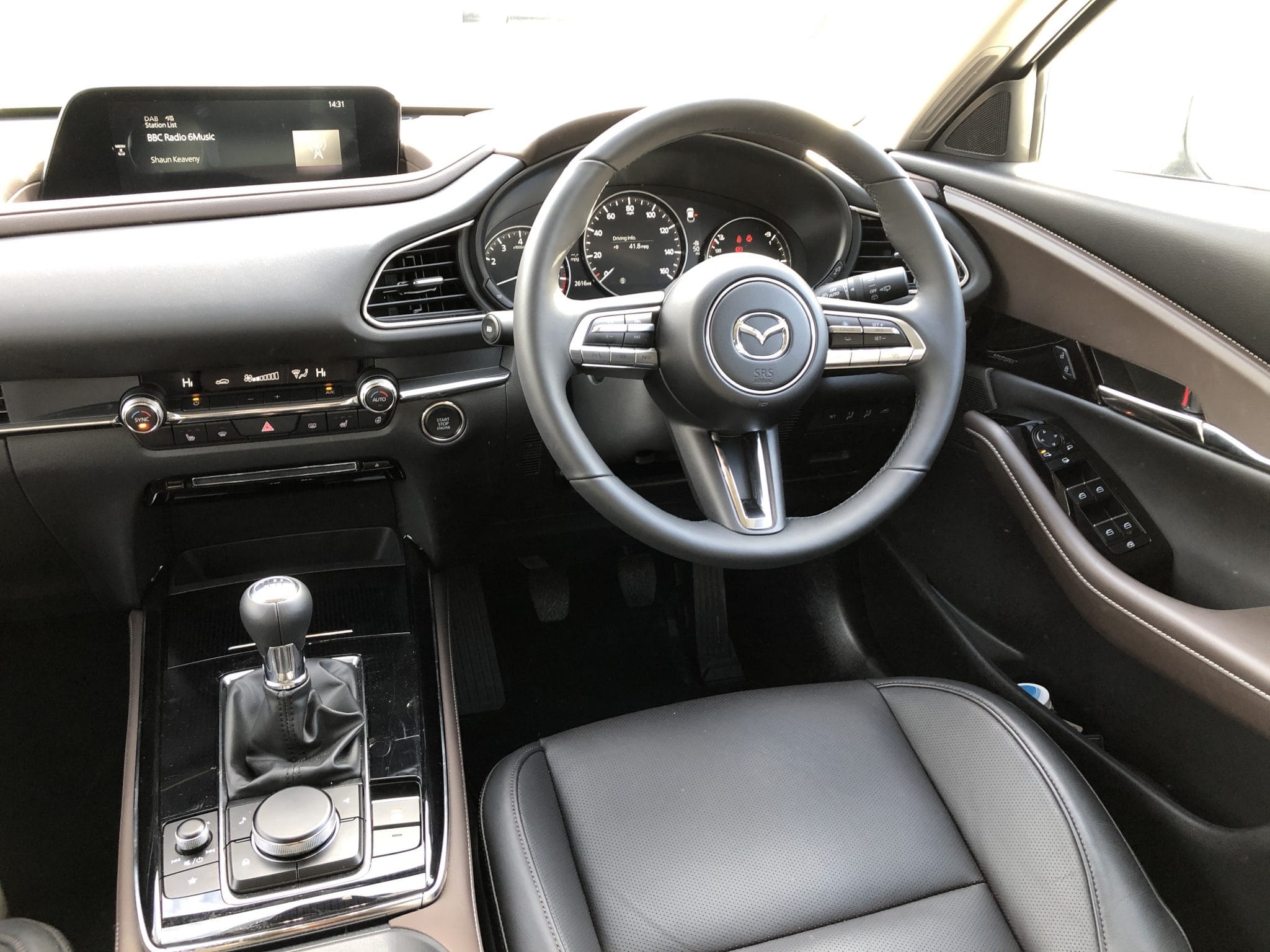
The climate controls & heated seat buttons are located under the infotainment screen with a CD input beneath this. In the central binnacle you’ll find a rectangular storage space under the dash, with two small drinks holders behind this. The gear stick sits behind these. The infotainment rotary dial is also located here, alongside a volume control knob & the electronic handbrake. There’s a lift-up armrest with storage underneath containing a single USB & 12v socket, with another USB located next to the CD slot.
The build quality, fixtures, fittings & finish in the Mazda CX-30 are universally excellent. The dashboard on our test car featured black leather, with rich brown interior accents, some nice touches of chrome & not a hint of cheapness to be found. The door lining was also finished in black & brown. The front windows are quite narrow top to bottom, which, whilst looking good from the outside, do tend to mean a lack of natural light in the cabin. Even with the addition of a sliding single sunroof it’s dark on board.
Up front, both front seat passengers get decent head & leg room, but in the rear, we were disappointed, struggling to see where the extra room comes from, compared to the smaller CX-3. The slightly, sloping, roof eats into rear headroom & if your driver or front seat passenger is tall, then it’s a tight squeeze for your legs if you’re sat behind them. In effect, Mazda has sacrificed interior space for a striking external profile, which does make it stand out in the sector. When compared to our family VW T-Roc, an obvious competitor, the cabin of the CX-30 feels a little claustrophobic.
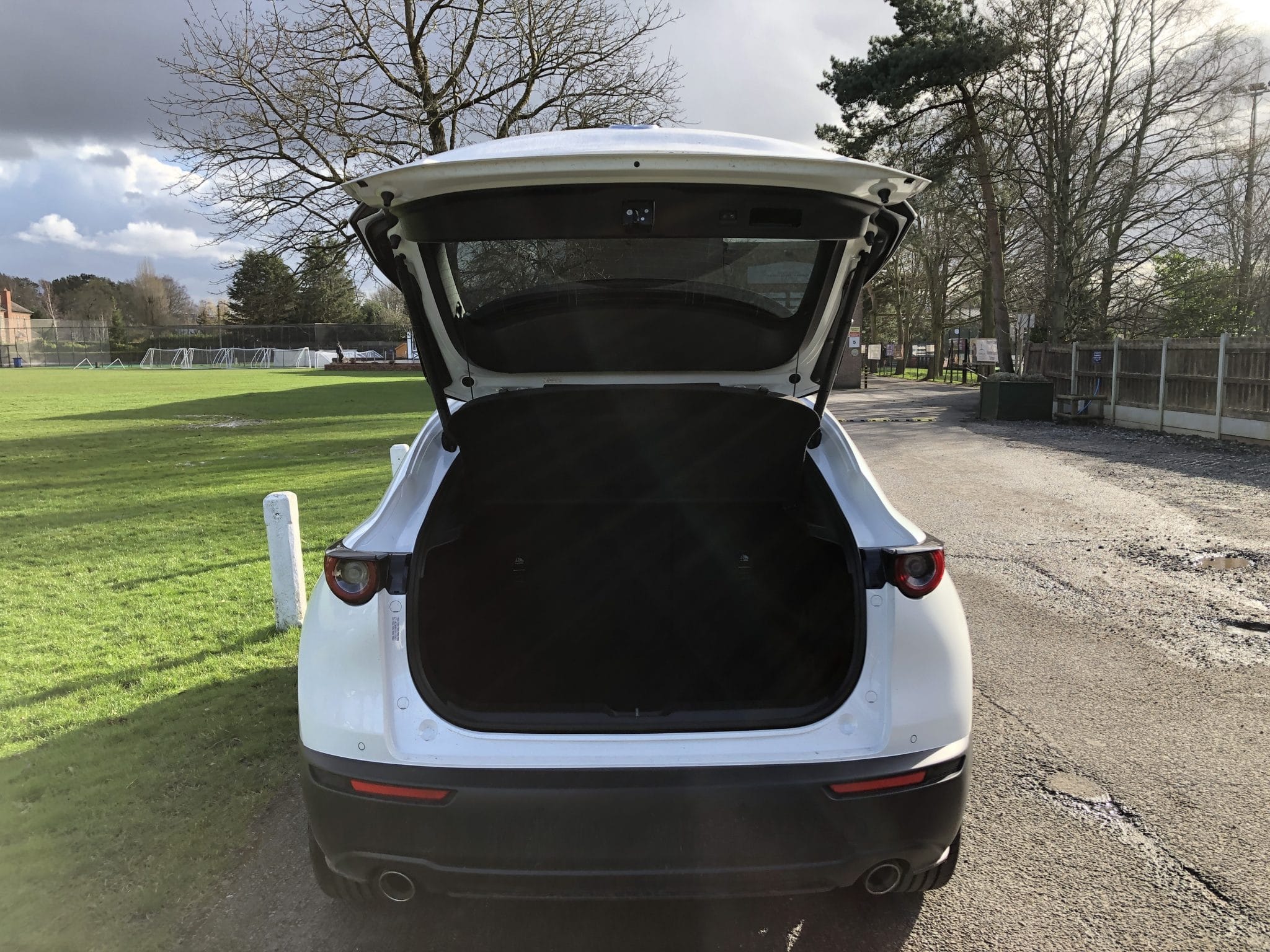
If you need a load lugger, the boot offers a decent 421 litres of storage, increasing to 1,398 litres with the back seats folded down. Access to the load area is decent & the boot will comfortably fit three large suitcases in, if required.
A trip to the North East, afforded me the opportunity to spend a good 3 hours behind the wheel each way & there’s no doubt the the CX-30 is a comfortable, quiet motorway cruiser, with the added bonus on our test car, of Adaptive Cruise Control making driving more relaxing.

As I discovered, the SkyActiv-X technology is great for fuel economy, as we averaged 42mpg in our week on board, (the claimed is 47.9mpg,) but the lack of low rev oomph, is really noticeable. For example, if motorway traffic slows & then speeds up again, the Mazda, which requires 3,000rpm to reach it’s maximum torque of 224Nm, is very slow to react. You have to disengage cruise control, change down from sixth gear, all the way down into fourth, just to get the car back up to cruising speed. Annoying to say the least. Mazda claim a 0-62mph time of 8.5 seconds, but with four adults & associated luggage on board, getting to 62mph, takes quite a bit longer.
On a more positive note, the six-speed manual gearbox is slick & around town the CX-30 is small enough to feel nimble. There’s little or no body roll by SUV standards & it’s an enjoyable car to be in. On our test cars 18″ alloys, which we felt are a little large for the car’s size, the Mazda tend’s to fidget over poorly maintained surfaces. We reckon the smaller 16′ wheels would be better.

We began by praising Mazda for the style of their latest models & to our mind the CX-30 is the icing on the cake. However, this beautifully crafted, physically attractive car is let down a little, by it’s lack of rear passenger space & if you like to drive your car, you’ll really notice the lack of pulling power when you need to accelerate, something that’s more readily on-tap, with Mazda’s diesel engines, which aren’t being offered on the CX-30.
The good new’s for business customers who choose a petrol CX-30 are that it comes both with attractive contract hire rates, with the 122PS version offering drivers a BIK from as little as £101 per month + vat.
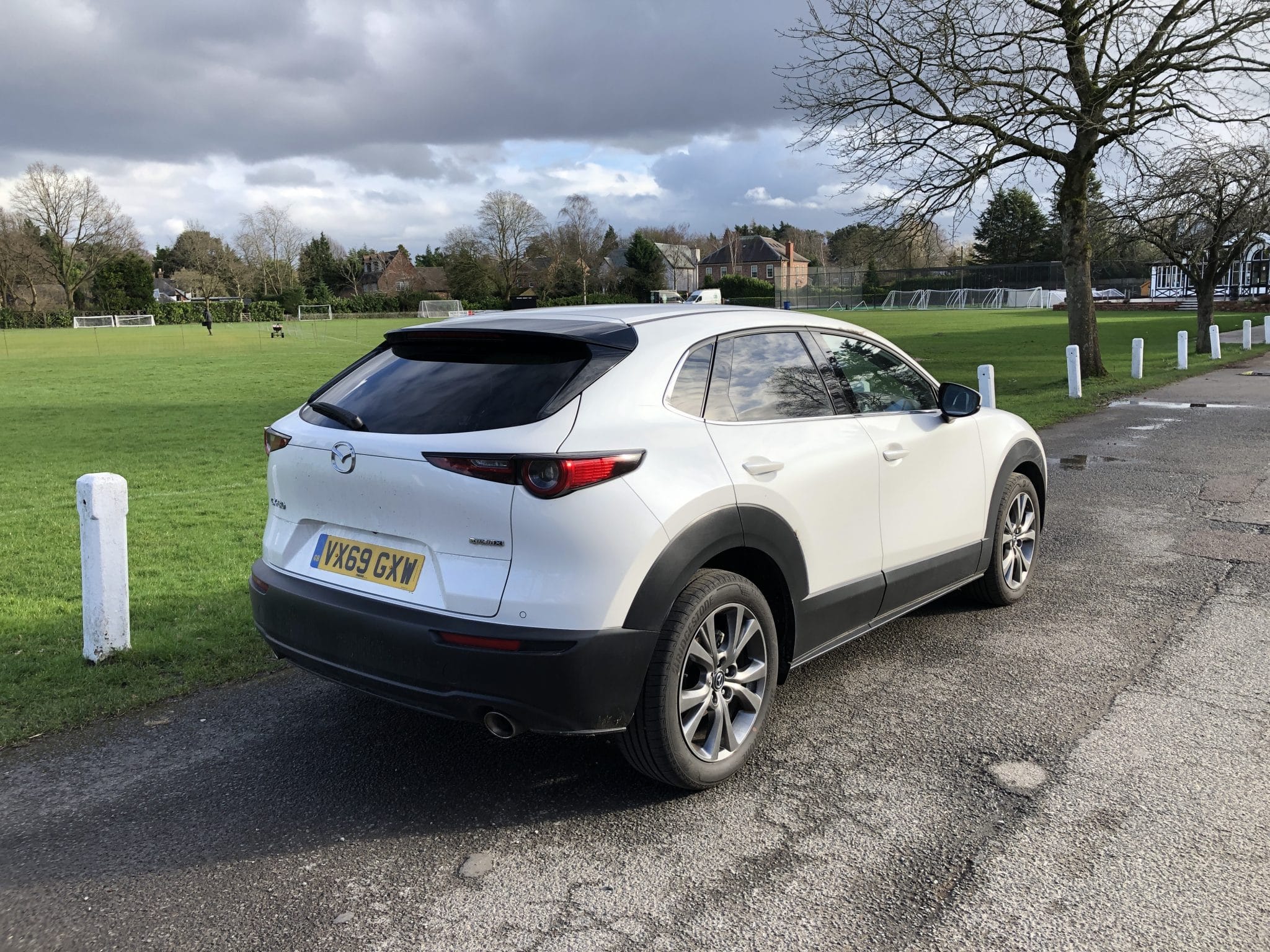
In conclusion, if you value looks over practicality & let’s be honest, the CX-30 is not that small, then the new Mazda will be right up your street. It’s stunning to look at, very well built, features all of the latest tech & safety & it’s available to fleet customers at a decent cost.
Oh you handsome devil, 3.75/5
