


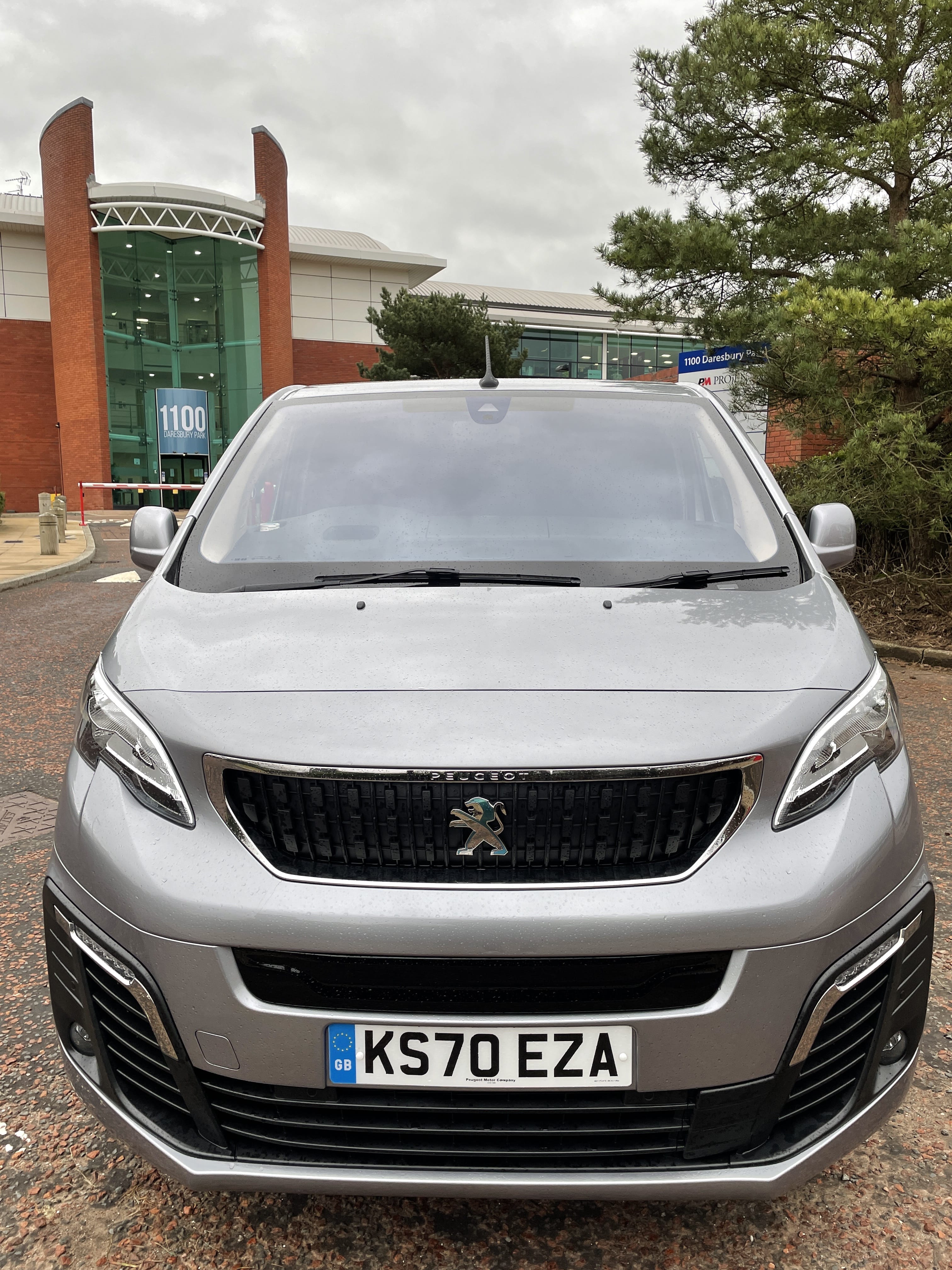
Alongside sibling Stellantis brands, Peugeot have a medium electric van, thePeugeot e-Expert. It offer’s a competitive payload, coupled to a driving range that will get you close to 200 miles between charges. And, like their diesel brethren, it’s very well made, comfortable to be in & comes equipped with up to date tech & safety features.
Specs
There are three trim levels available for the Peugeot e-Expert; S, Professional & Asphalt. S & Asphalt models come only in a Standard wheelbase version, while Professional vans can be Compact, Standard or Long in length. All are comprehensively equipped, so S gets a steel bulkhead, twin sliding doors, daytime running lights, Bluetooth, DAB radio, cruise control with speed limiter & Peugeot Connect SOS & Assistance.

Professional spec adds a 7″ colour touchscreen infotainment system, Apple CarPlay & Android Auto, whilst range topping Asphalt, includes SatNav, a head-up display, Lane Departure Warning, Park Assist, reversing camera & Autonomous emergency braking.
Powertrain
Having awarded the Peugeot e-208 our Small Electric Car of the Year Award for 2020 & 2021, it’s comforting to know that the the e-Expert uses the same 136hp electric motor that you’ll find in Peugeot’s e-208 & newer e-2008 electric cars.
Both cars are fitted with a 50kW battery, whereas the e-Expert, having to carry a larger payload than the Peugeot electric cars, is offered with a choice of two batteries, either 50kWh or 75kW. Under the WLTP rating, the smaller battery offers a range of 143 miles, whilst the 75kW version will take you onto 205 miles.

Payload
The 75kW battery is heavier, therefore the smaller battery versions offer the largest payload, in this case 1,226kg, whilst the 75kW battery powered models offer a 1,001 kg payload. The e-Expert will also tow up 1,000kg.

Charging
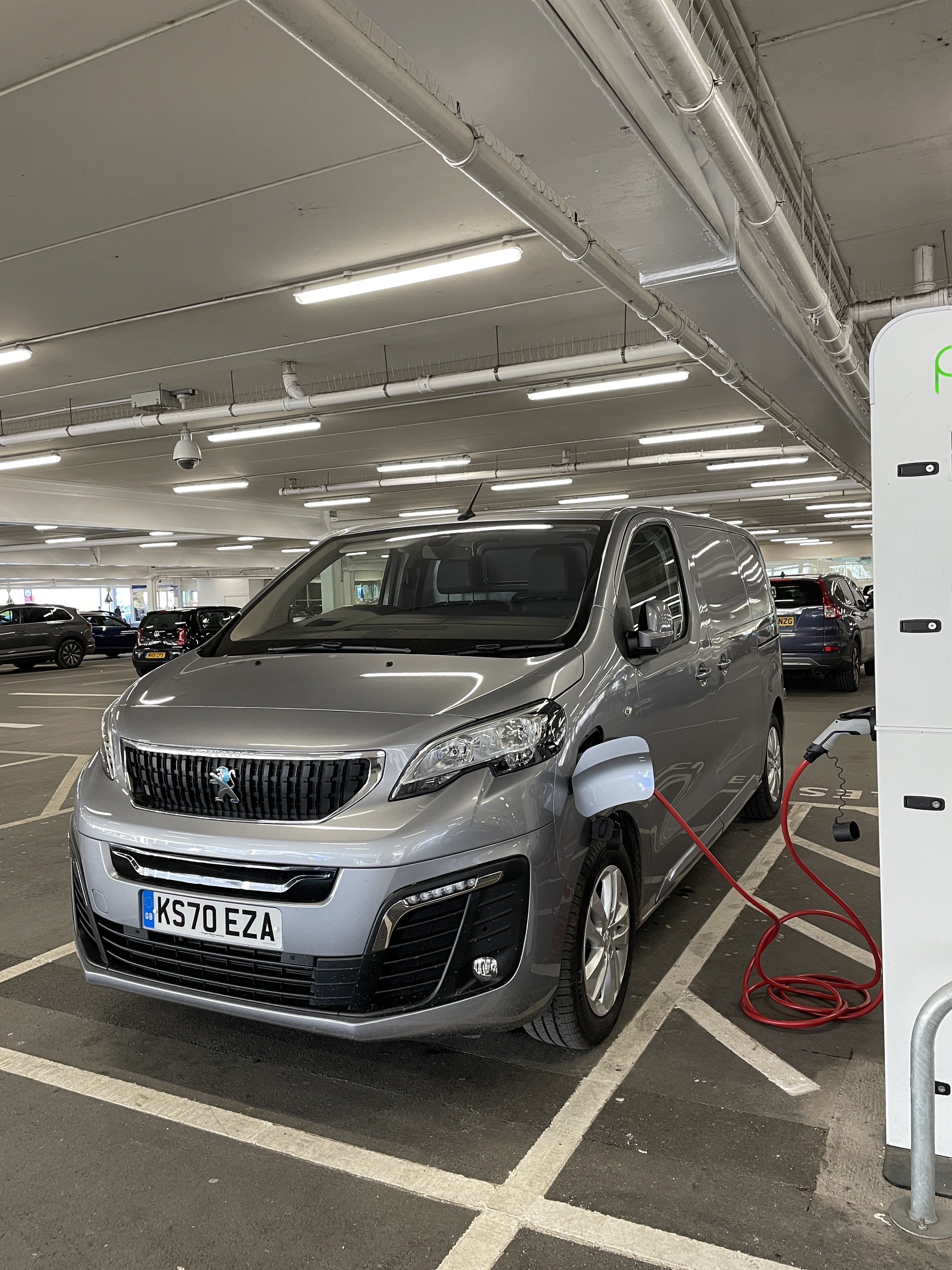
Potential customers will want to know the charging times. Using a standard 7.4kW home charger, the smaller battery takes 7 hours 30 mins & the larger battery 11 hours & 20 mins to charge from empty. Plug into a more powerful 11kW wall box & these times are reduced to 4 hours 45 mins & 7 hours respectively. It’s worth noting, that if you utilise the MyPeugeot App, you can enable remote cabin pre-conditioning & pre-programme your e-Expert to charge up at night when some energy suppliers offer a reduced tariff.

If this is too slow for you, you’ll be pleased to know that the e-Expert is also compatible with very powerful public chargers right up to 100kW, which will give the smaller battery an 80% charge in 30 minutes, or the larger battery an 80% charge in 45 minutes.
Exterior
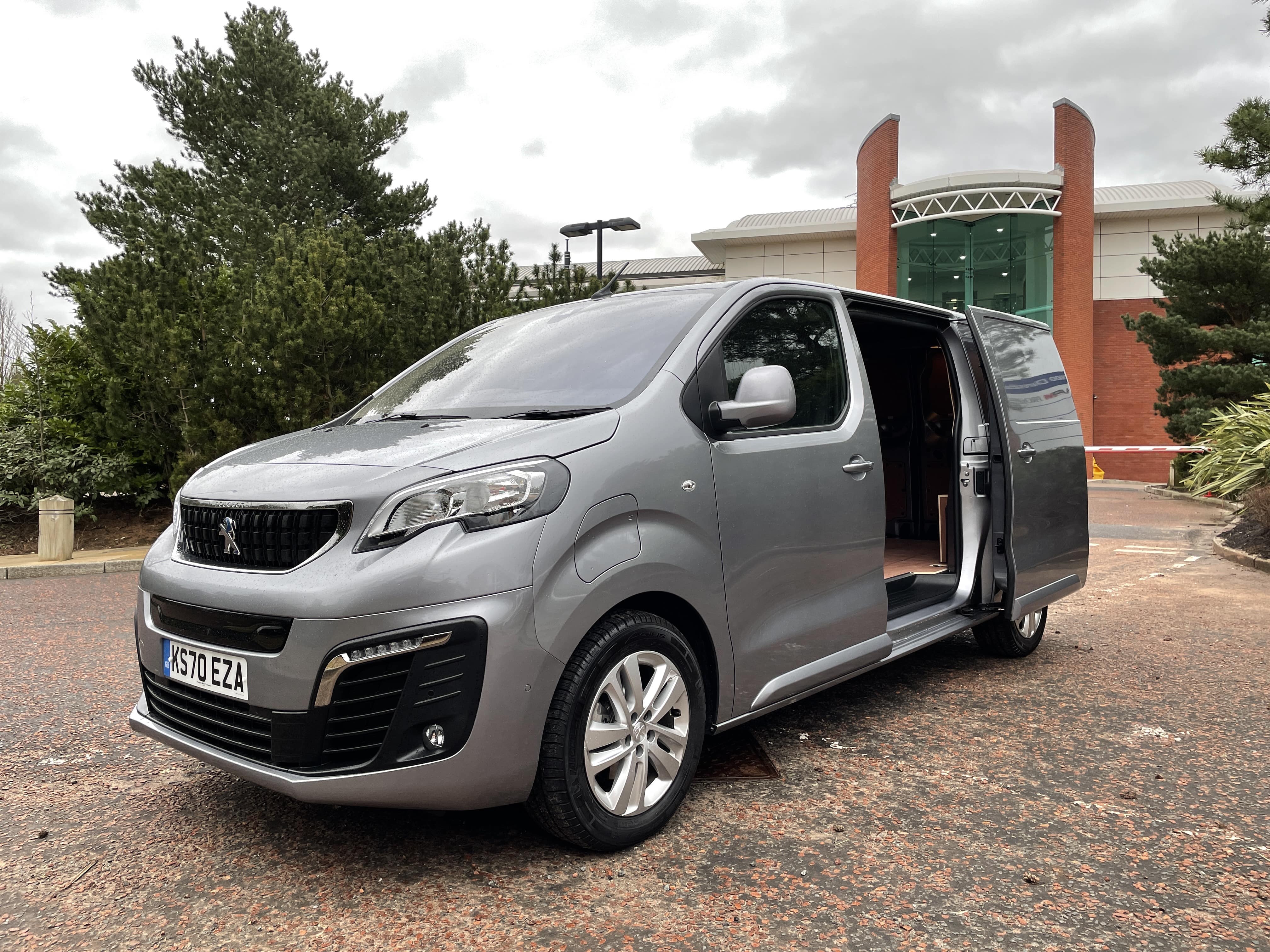
We were testing the e-Expert 75 kWh Auto Asphalt Panel Van. It looks just like the diesel model, with just a couple of nods to it’s electric roots, namely a blue e on the front grille & on the rear door in front of Expert & of course, the charging port located on the left hand side front wing.

Interior
Inside, you’re greeted by a car-like set up which is finished in decent quality plastics. The dashboard is dominated by the 7″ Colour touchscreen, whilst the general layout of buttons, switches & steering wheel controls, are all logically located & are easy to reach. You’ll need to enter the touchscreen for most functions , but the set-up is very intuitive.
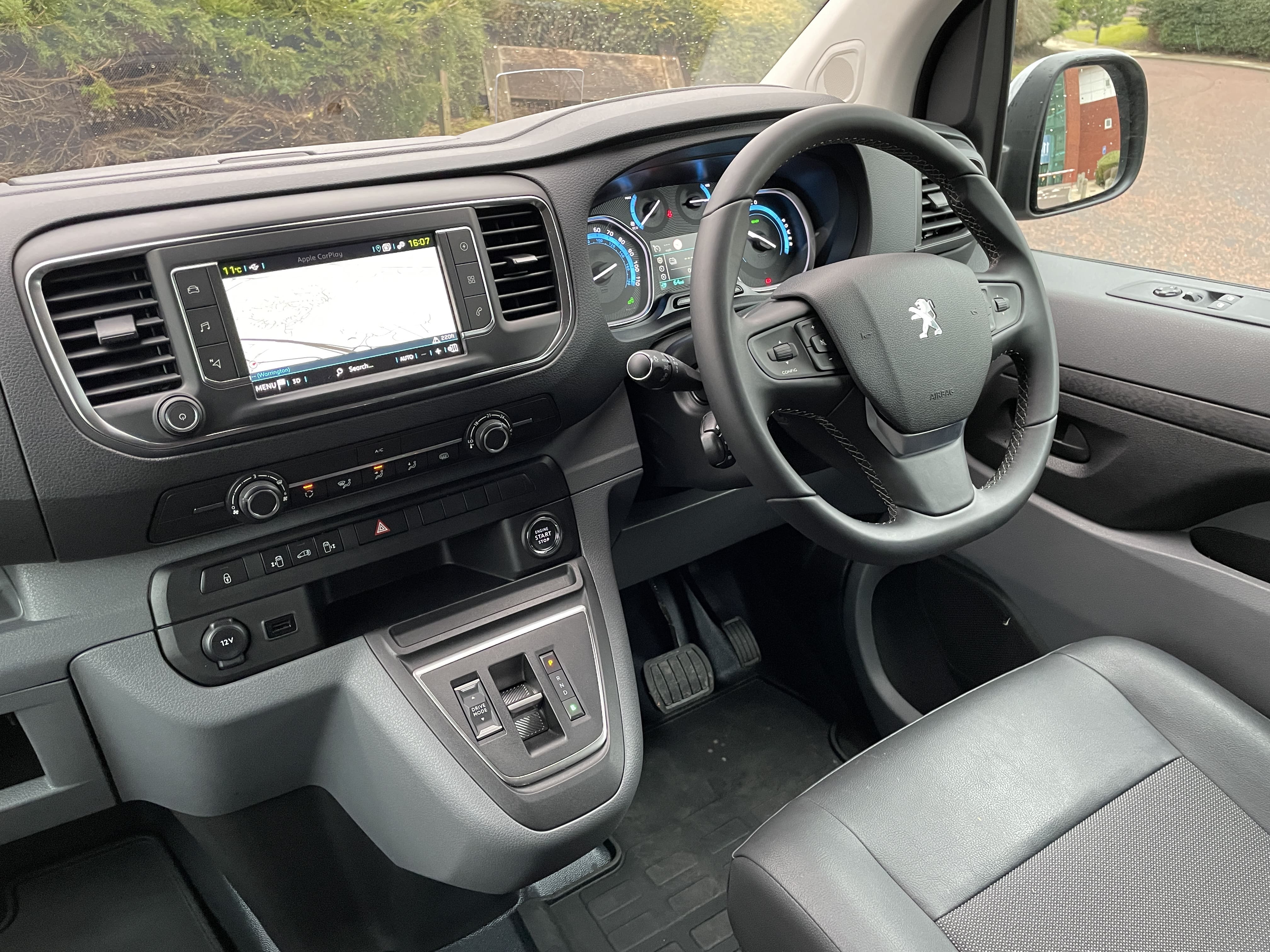
There’s a total of 49-litres of storage space around the cabin, including large door bins, two glove boxes on the passenger side & an A4 sized covered compartment on top of the dash, plus dash-top drinks holders.
Our test van featured Moduwork bulkhead with a hatch, allowing an additional 1160mm of load length to fit into the cargo area & into the front rear left passenger footwell. There was also a triple-seat folding front bench with under seat storage on both passenger seats.

Driving
As with all EV’s, the e-Expert is god fun to drive in town. All models use an auto gear change with 3 driving settings. Sport, Normal & Eco, with each offering slightly different amounts of power. So Sport is best utilised when you are carrying a heavy load, Normal works well for every day use & Eco reduces the power output & vans climate control to give you an increased battery range.
Forward or reverse movement is undertaken via push-buttons for Drive, Reverse, Park & Brake regeneration. Couple the Eco drive mode with the vans built in B regenerative braking & you can add range to your e-Expert especially in slow moving traffic, or on roads with plenty of traffic lights & roundabouts, where the van slows down & the brake regeneration will kick in.
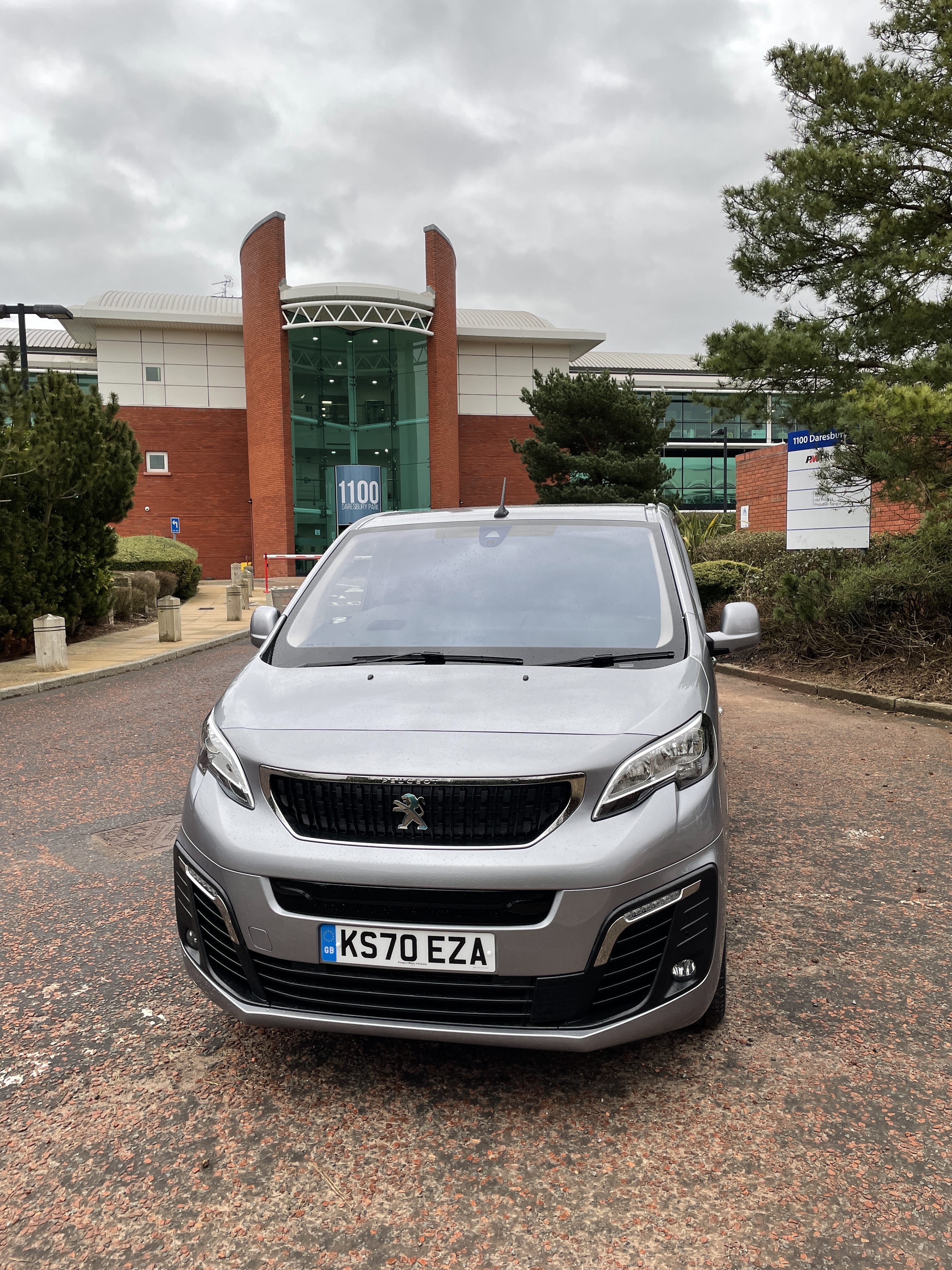
Driving on urban roads is really enjoyable as the e-Expert offers swift progress at lower speeds. The ride doesn’t feel too harsh & the battery which is located underneath the loadspace, doesn’t make the van feel cumbersome.
At speeds of up to 50mph driving in Eco mode, the e-Expert will comfortably return one mile of distance travelled to one mile of battery range. However, if you’re used to making rapid progress on the motorway in a diesel van, you’ll need to re-think how you drive on the motorway in the e-Expert. If you drive your e-Expert at over 60 mph, then the battery range drops considerably, as we discovered. In order to conserve the battery range, it’s best to stick to speeds of no more than 55-60mph & as you’ll discover, you’ll keep a 1:1 ratio of miles driven to range used.
Furthermore, if you take the plunge & get an e-Expert, or indeed any electric van, you’ll find that you will become obsessed with conserving battery energy & over time, will work out how to do this without compromising the work your van is required to do.

Connectivity
The e-Expert features two USB’s up front, a standard & a C fitting as well as two 12v sockets. We connected our iPhone via cable to set up Apple CarPlay & utilised this to make & receive hands-free phone calls, listen to podcasts on the iPhone & access Google Maps. We’d suggest that the Professional specced e-Expert range offers you everything you need in this respect.
Servicing & Warranty.
One year or 12,500 miles for service one, & then serving revert’s to every two years or 25,000 miles. The whole van gets standard coverage of three years or 100,000 miles, with the first two years being unlimited mileage. Battery components are covered by a reassuring eight-year, 100,000 mile warranty, while secondhand vans will be offered with battery certification to assure buyers they can still cover a good distance.

Positives.
With no diesel full bills, you’ll find that filling your e-Expert will cost you a quarter to a fifth as much as a diesel Expert to travel the same distance, especially if you utilise cheaper charging tariffs at night. Electric vans are simpler beasts than diesel vans, with fewer moving parts. So factor in less maintenance – there’s no clutch for example – & cheaper servicing. Electric Expert offers the same load space as a diesel Expert & all e-Experts come very well equipped. And, at the time of writing, only the Chinese built Maxus e-Deliver 3, which comes with a smaller payload, can offer anything close to the e-Expert’s 211 mile electric range.

Negatives.
Charging time is slow, especially if you are running the larger 75kW battery e-Expert, 11.5 hours from zero to full. And cost, our test van will set you back £43,661, so you’ll need to run your e-Expert for a while before the extra cost levels itself out. And although the cabin seats three, whoever draws the short straw & sits in the centre seat will find legroom especially tight.
Overall
Whilst range anxiety may still put many off an electric van, we suggest that operators look long & hard at their own commercial fleet, to see if all of their vans are being driven long distances all of the time. If not, then the excellent 200 mile range offered by Peugeots e-Expert, coupled to it’s tax saving zero emissions & cheaper running costs, should make the decision to change to an EV that much easier. And, as far as electric vans go in 2021, the e-Expert offer’s one of the best all around packages, for battery range, payload, on board tech & safety of any electric van you can buy.
4/5
