


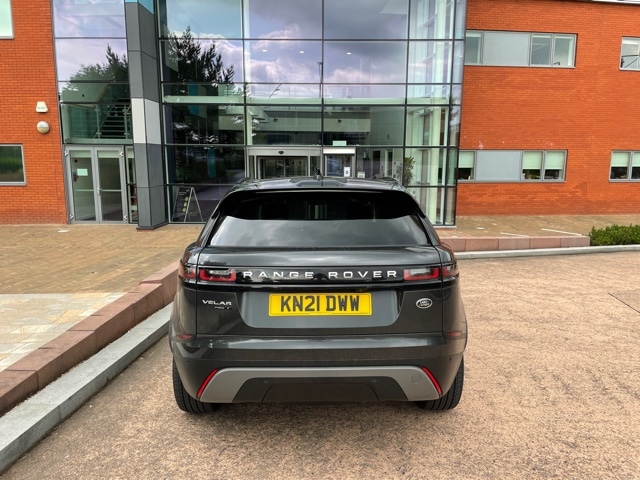
We drove the Range Rover Velar back in late 2017 & came away impressed by it’s stunning good looks & quality interior. Offered in a choice of petrol & diesel engines, the upgraded Velar now comes with a company car friendly plug-in-hybrid, the Velar P400e. The new model shares both it’s name & it’s set-up, with the recently launched Jaguar F-Pace P400e & our first drive came in July 2021, behind the wheel of the P400e S, which retails from £61,770 on the road.

Engine & drivetrain
It’s powered by a 296bhp 2.0-litre four-cylinder turbocharged petrol engine, that’s mated to a 141bhp electric motor, which itself is powered by a 17.1kWh battery pack under the boot floor. You get an eight-speed automatic gearbox & it’s 4WD. The petrol engine coupled to the electric motor, generates 404bhp with 640Nm’s or torque, so it’s powerful enough to offer a 0-60mph time of only 5.1 seconds & a maximum speed of 149mph.

Specs & what’s new
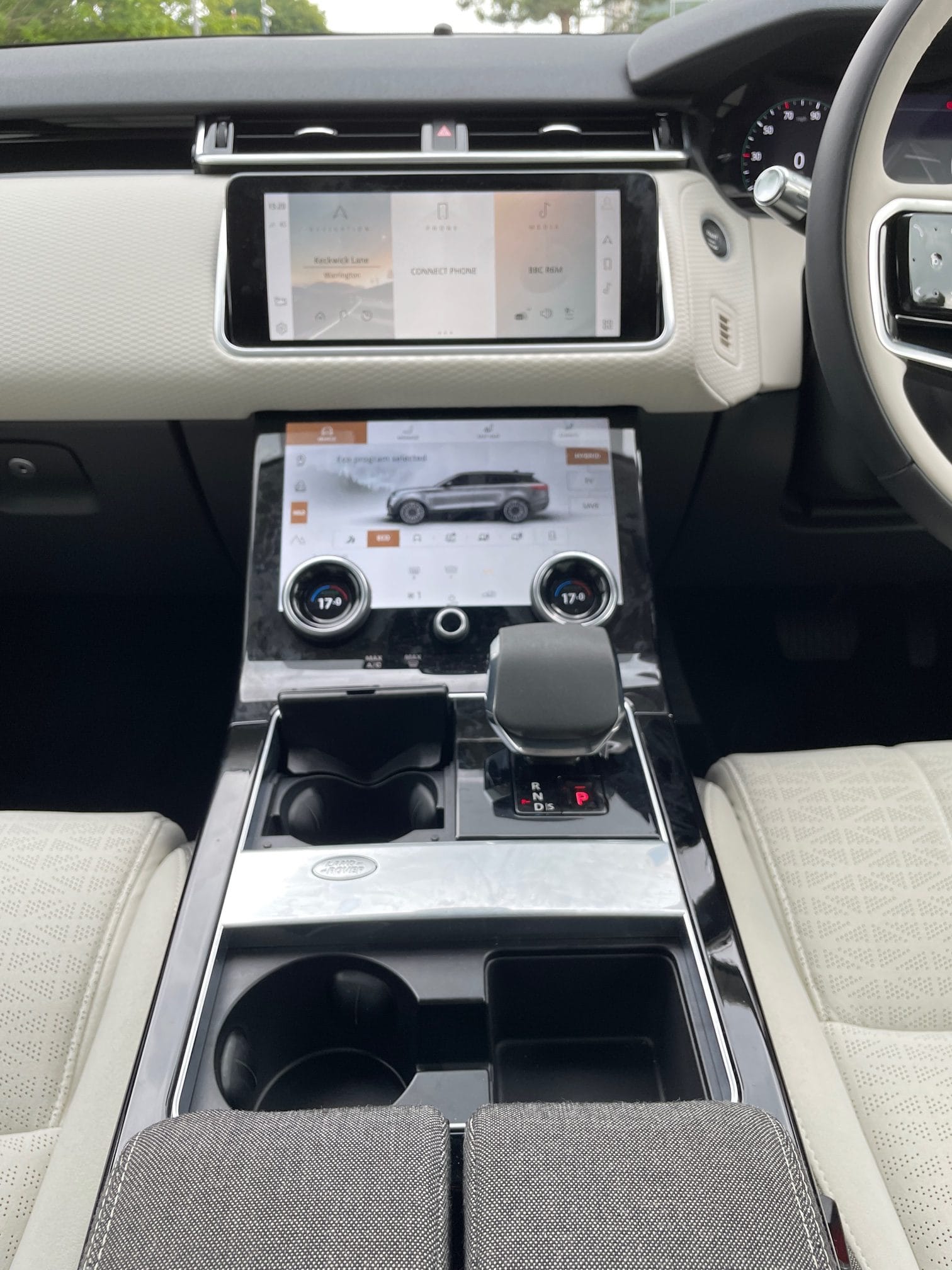
There’s a new steering wheel, the gear-lever has been changed, the lights are full LED & there are some new paint colours. There’s an much improved infotainment system, with touch friendly screens & their larger too.
Entry level Velar P400e comes with 19″ wheels, front & rear LED headlights, eight-way electric heated seats, Luxtec & suede cloth seats, a tailgate slotted spoiler, black roof rails, a Smartphone Pack consisting of Apple CarPlay & Android Auto, Pivi with 10″ Touchscreen & a 3D camera.
Our test car the S, up’s the ante with leather all-round, a Meridian sound system, 14-way heated driver memory front seats, a powered tailgate & Traffic Sign Recognition & Adaptive Speed Limiter. More expensive SE, HSE & R-Dynamic, add larger alloys, Adaptive Cruise Control, an enhanced Pivi Pro system & more interior & exterior bodywork.

Practicality
Thanks to the addition of the battery, the plug-in version sees boot capacity with all seats in place drop from 513 to 440 litres, which may put some off. The cabin though, features decent storage, with twin cup holders & a useful rectangular space in the centre binnacle, some useful space under the centre armrest, which also contains twin USB’s, four good sized door pockets & medium sized glove box. Rear seats feature pull out seat storage on the back of the front seats, pa pull out armrest with twin cup holders, a 12v socket & single USB.

Company car appeal
Despite the power on tap, the combination of petrol plus battery, emits just 49-58g/km of CO2, dependant on model, making it an 11% tax-saving BIK proposition. Add in the combined claimed fuel economy of 132 mpg & a 33 mile pure electric range & it’s a very attractive proposition.

Charging
The P400e comes equipped with a standard charging cable. Using our own Rolec 7.2kWh home charger it took the Velar’s 17.1kWh battery, 1 hour & 45 minutes to charge from empty to full. Interestingly, the Velar can also be rapid-charged up to 32kWh with a 0-80% battery range taking just 30 minutes.
Driving modes
The P400e gets Hybrid & EV settings. Hybrid allows the car to flip between petrol, electric or both. EV puts the car into full electric mode, by turning off the petrol engine. As with sister model the Evoque P300e, you can also access an Eco mode, which cuts down on the petrol engines power in petrol mode only. Or you can access the EV settings, where you can choose to Save your battery for urban driving, where you’ll get the most out of the electric range.
Driving
The eight-speed gearbox is a joy. Hybrid is the default mode & the engine switches seamlessly in near silence between the petrol & electric motors as required. The quietness has been enhanced with an update that has seen Land Rover fit noise cancellation software, which does a really good job of shutting out wind & road noise.
On the motorway, the Velar makes serene progress, but if required, when you put your foot down, the petrol engine emits a satisfying growl, as it swiftly overtakes slow moving traffic. Front seat passengers sit comfortably high, in large, airy seats & you get a good view fore & aft from the largish windows.

In town & on local roads, the P400e does feel a little sluggish, especially when compared to the smaller, lighter Evoque plug-in. Furthermore, thanks to the battery, the P400e doesn’t have the option of air suspension, so only coming with steel springs. Surprisingly, it isn’t that noticeable & the car feels less cruise-liner-ish than the air-suspension versions, not a bad thing at all.
As far as fuel economy goes, we drove almost 300 miles in our week on board the P400e, of which a third was in pure electric mode. Petrol consumption sat in the early-thirties mpg, but when combined with the battery, early fifties mpg was the result, some way down on the 100 mpg + that many PHEV’s claim. Charging at home was quick & easy & we utilised the free local Tesco Pod Point charge points as well. I also set the timer in the EV settings, so that we could charge up at the cheaper time of 00.3o-04.30 am, which was extremely useful.

Off road
The electric powertrain doesn’t affect the Velar’s 4WD abilities. All PHEV models come with features that will take you off-road; Terrain Response, All Terrain Progress Control (ATPC), Low Traction Launch, Hill Descent Control (HDC), Torque Vectoring by Braking, Passive suspension & Hill Launch Assist. However, the lack of air-suspension means you can’t raise the ride height if you are off road.

Pros
Beautiful to look at, much-improved infotainment, top-quality interior, go-anywhere credentials, decent electric range & 11% BIK.
Cons
Expensive, a little sluggish in town & on country roads & comes with a slightly higher BIK than some competitors.

Conclusion
If you’re lucky enough to be in the sector for an executive SUV, then the Velar PHEV is hard to fault.Whilst it’s expensive to buy, it’s low BIK should encourage fleet customers to consider one through their company car scheme. And for those who do, they won’t be disappointed.
4.25/5
