


We first drove the Renault ZOE back in 2013. With a price tag of £13,995 after the then Government’s £5,000 plug-in vehicle grant was applied, it was a bargain. But, the cost at the at that time didn’t include the battery, which was subject to a rental from £70 a month or 7,500 miles on a three-year contract. And, the first ZOE, came with a caveat of just a 62-93 mile range.
As electric cars evolved, in 2015 the ZOE i was introduced, with a battery pack included. This added £4,500 to the price with the battery covered by a five-year/60,000-mile warranty & in Expression Nav & Dynamique Nav, spec,increased the battery range to a more useful 149 miles.
As the competition in the EV sector hotted up, Renault went back to the ZOE & in 2020, increased the battery range further, with the latest version offering a claimed 238 mile WLTP range.

Post pandemic, Renault delivered CC&V this improved ZOE, a GT Line R135 Z.E 50, with a retail price of £32,295 & a monthly contract hire rate of £215 + vat per month.
Seven years ago, the ZOE was probably, the most normal looking electric car you could buy. And the latest ZOE arguably still is, resembling an everyday small family hatchback, very much like sister model the Clio.
Visually, the latest version has had a few tweaks. At the front, there’s a deeper bonnet with a chrome edge & larger Renault logo, that still doubles as the charging point cover. The fog lights are more pronounced & the lower grille is now wider & inverted. The rear & sides appear unchanged, with the hidden rear door handles still a feature.

Inside, the changes are more noticeable. The dashboard is darker & is now dominated by a central 9.3″ portrait touchscreen. Gone is the old handbrake replaced by an electric one & the new 10″ customisable drivers display comes in for the old rectangular display found on the Mk 1. There are three climate control dials instead of the one from before & a line of switches above this ,which include the heated front seats has ben added, which is basically the same set-up as in the latest Clio. Up front there are now two USB inputs, with another two located in the rear. The quality is about the same. Front seat passengers get some small storage located on the dash front & two drinks holders between the front seats. For rear seat passengers, there’s still no drinks holders or rear door pockets to store anything. All in all, it’s actually a more conservative interior than before, an attempt perhaps, to widen the ZOE’s appeal.

Z.E. specific equipment includes the supply & fit of a 7kW ready domestic wall box at our home for free, for retail customers, XZ.E Services, which offers a 3 year subscription, for remote battery charging, remote pre conditioning & charge scheduling & a Z.E Voice low speed warning.
Key safety features on the GT Line are Lane Keep Assist, Lane Departure Warning, rise control with speed limiter, Traffic Sign recognition, Blind Spot Warning Electronic Stability Control. Outside, you get 16″ diamond cut alloys, a chrome stamped grille & body coloured door handles & wing mirrors.

Convenient tech incorporated is, automatic climate control, front & rear parking sensors, a rear reversing camera, a wireless phone charger, Apple CarPlay & Android Auto, Bluetooth & a 4 x 20W amplifier FM DAB double tuner sound auditorium.
The GT Line we tested also came with the addition of a 50kW rapid charge cable & fitting, an additional £1000 over list price. This sees an 80% charge delivered in just 70 minutes.
Top speed is 87mph, with 0-62mph achieved in 9.3 seconds. Like many electric cars, the acceleration is quickest from 0-30 mph. With zero tailpipe emissions the ZOE comes with 1% BIK, a massive incentive for company car drivers.
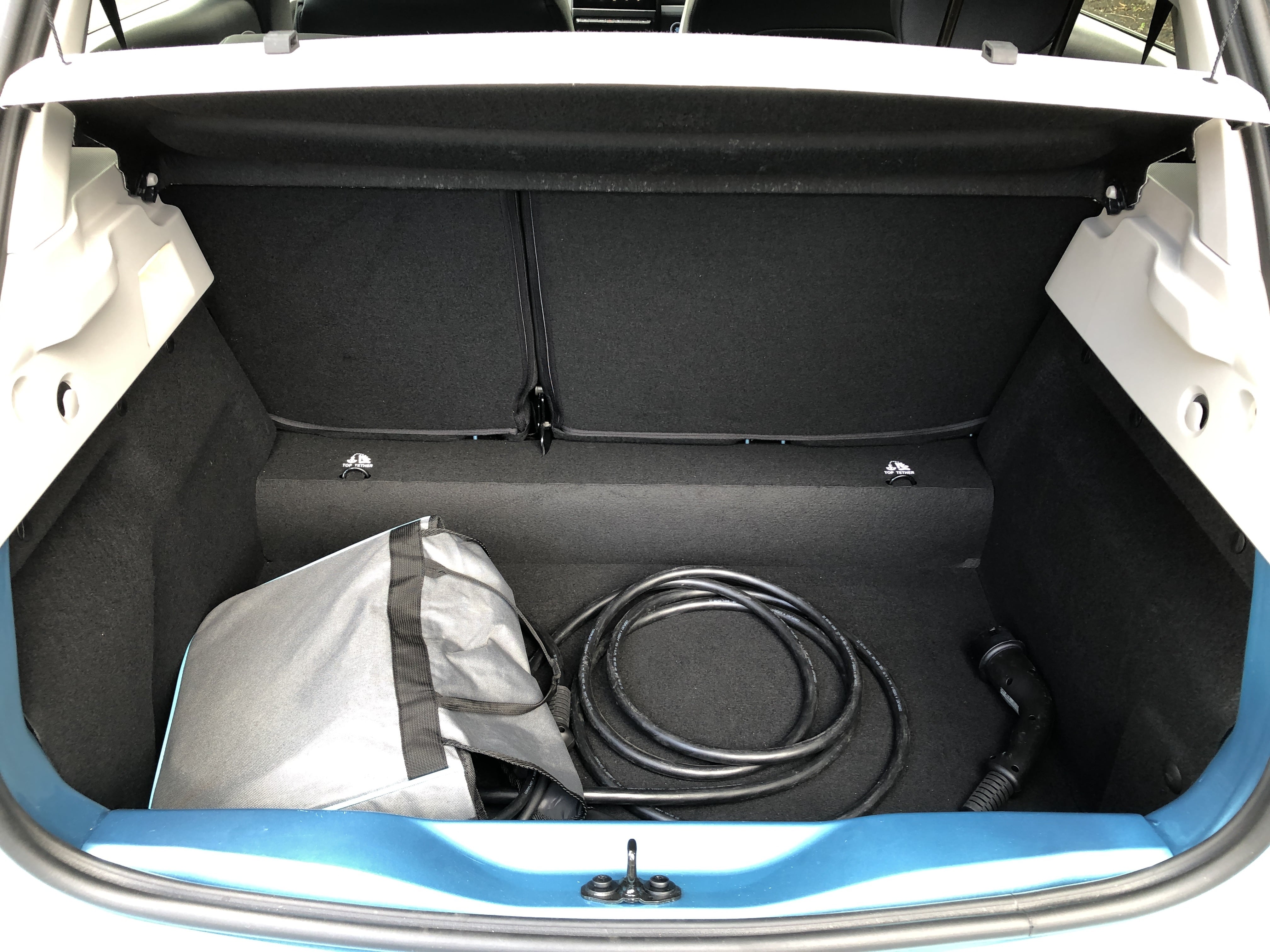
Front seat passengers have decent head & leg room in the ZOE, but in the back, there’s really only enough space for two passengers. The boot offers up storage of 339 litres, or if the rear seats are folded down,1225 litres.
There’s an automatic E-shifter gear on the ZOE, which features ‘B’ Mode, for increased regenerative braking & one pedal driving, which is similar to the system found in Nissan’s Leaf. This is easy to get used to & adds a few extra miles to your range when regularly engaged.
On the road, the new ZOE drives a lot better than it’s predecessor. The ride is still a little fidgety, but the the steering is fine & the experience is not unlike any small car. At low speeds, the friction braking that’s now commonplace in most electric cars, can take some getting used to. Novices may find that the ZOE slow’s down too quickly & thee’s an urge to press the brake pedal But after a few drive’s it’s really easy to get used to & becomes commonplace. We left the ZOE in regenerative ‘B’ mode all the time.

There’s also an ECO function, offers on the ZOE, which when activated, slows the car down quite considerably. We found it most useful around town or in local driving. On the motorway in you are in ECO, you are limited to around 60-65 mph, so in our experience, it’s best to disengage from this, to achieve a more realistic 70 mph motorway speed.

Our test car was delivered with 213 miles of range. We took it out & at a mostly a motorway speed of 70-75mph, drove 84 miles, which reduced the battery range on our return to 97 miles. So, we used up 116 miles of range when driving 84 miles. What this illustrates is that if you use your ZOE purely on the motorway, it will use up the range much faster than it would, than if you drove it around town. For example, utilising the B-Mode regenerative braking, in town & locally, we drove 21 miles & from the 97 mile range we began with, now had 83 miles remaining. In the calendar week we drove the full 213 miles offered when the ZOE was delivered, but in order to achieve this, plugged it in for 6 hours & left it to be collected with 49 miles remaining. We would say the the actual range of the ZOE, when using the motorway regularly, is around 180 miles. In town & with just some local driving, the range is likely to be 220 miles. A good compromise then is 200 miles.

When we drove the ZOE in 2013, electric cars were a novelty & many said that they would not catch on. Back then, there were only 1300 public EV charge points in the UK. In 2020 there are over 30,000 & every car brand is in the process of developing or has built an electric car. The ZOE offers fleet customers the dual incentive of a 1% BIK, coupled to a real world range of 220 miles. It may not have the looks of the Peugeot e-208, or the 270 mile range of the KIA e-Niro or Hyundai Kona EV, but it’s a pretty good all-rounder & that free wall box is a nice incentive too.
An Ed Straker 3.75/5
As of July 23 2020.
i Iconic R110 Z.E 50. Advance payment of £1194. Followed by 35 payments of £199 + vat per month
i GT Line R135 Z.E 50. Advance payment of £1290. Followed by 35 payments of £215 + vat per month
i GT Line R135 Z.E. 50 Rapid Charge. Advance payment of £1374. Followed by 35 payments of £229 + vat per month
