


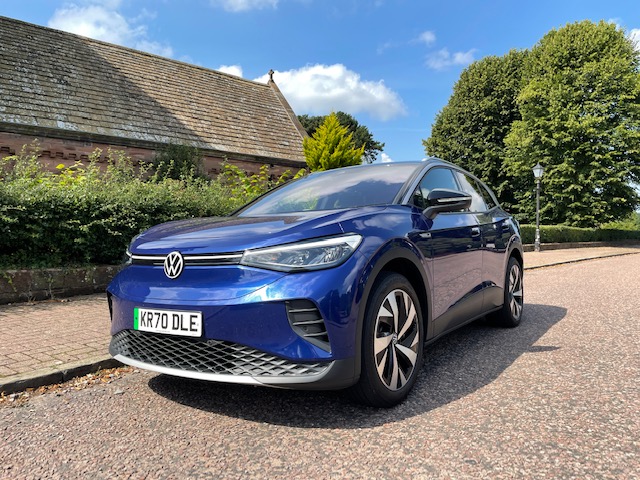
The ID.4 is Volkswagen’s first fully-electric SUV & the brand’s first global electric vehicle. Like the ID.3, it’s based on the brands modular, electric drive matrix (MEB) & it’s entry into the compact SUV market has given Volkswagen a competitor in a sector that sees no sign of slowing
Model range & battery choice
Entry model is the 109kW City Pure 52kWh costing £34,650, with eight more specs; Life, Style, Life Edition, Style Edition, Family, GTX, Max & GTX Max versions offered, right up to the range topping 220kW 4Motion GTX Max 77kWh which will set you back £58,415.
The smaller 52kWh batteries come with a range of 213-223 miles. The larger 77kWh batteries offer 288-322 miles & the largest 82kWh batteries, available on Life Edition, Style Edition & GTX versions will give you 301-325 miles of range.

Exterior
Unlike the ID.3 which looks very much like a Volkswagen, the ID.4 looks generically like a lot of traditional SUV’s, so think Vauxhall Grandland, Nissan Qashqai & KIA Sportage.
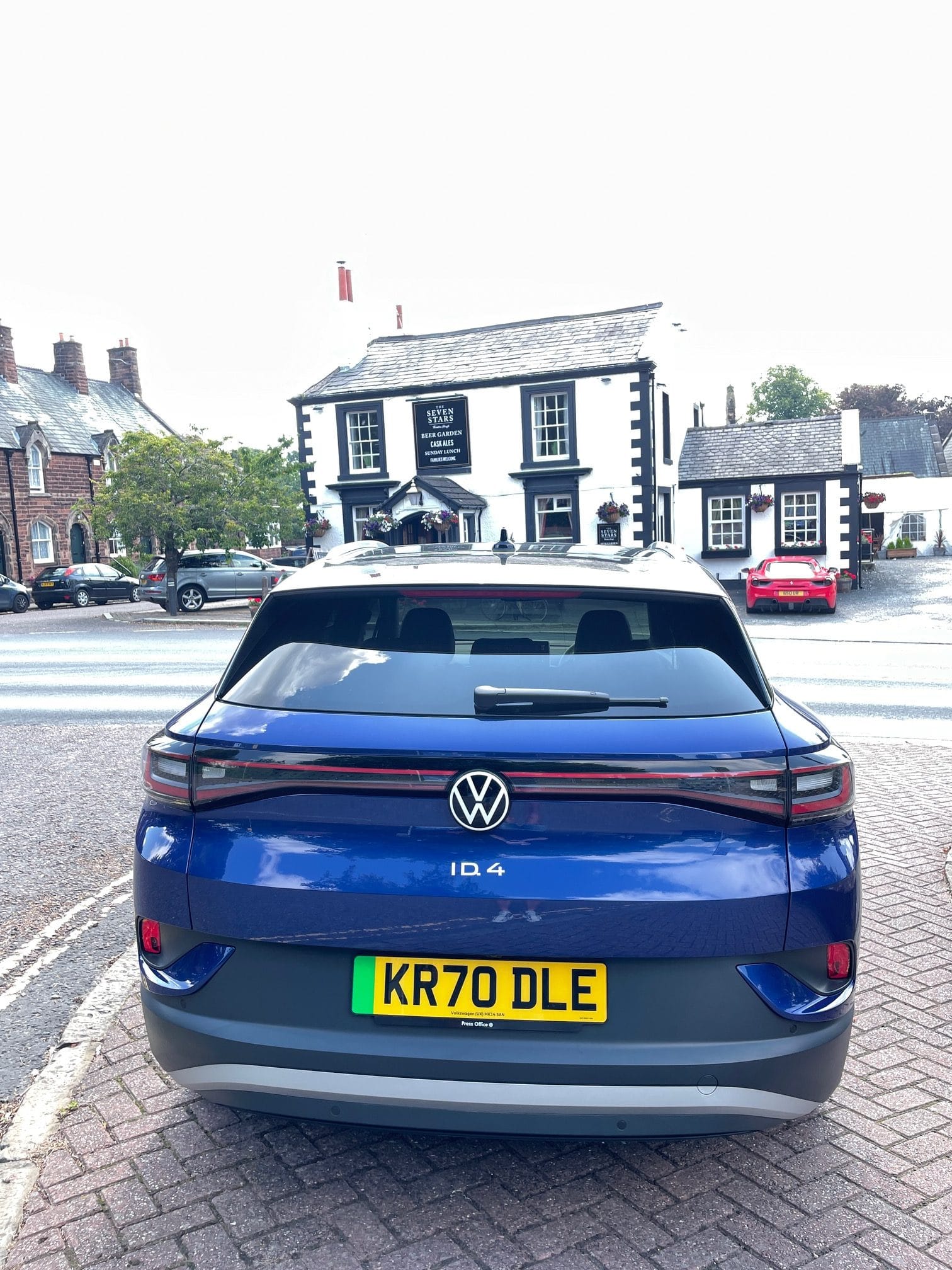
The front of the ID.4 features narrow, sweeping front lights & a large windscreen. Mirroring the latest Audi EV trend, the rear light cluster spreads right across the back of the car. The VW badge is prominently located centre front & rear with the ID.4 logo located on the centre rear.

Interior
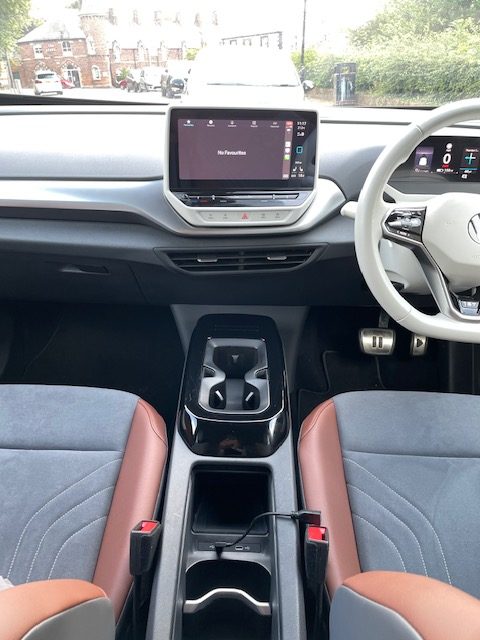
The interior is almost identical to the one found on the ID.3. So factor in a centrally mounted 10″ infotainment touchscreen, a 5.3″ dash panel display, a flat bottomed steering wheel & a gear lever on the right end of the centre console that you twist to select from Drive, Reverse or Neutral. Build quality is pretty good, although there are some cheaper, harder plastics located lower down.

Practicality
The interior offers at least as much room as you’ll find in a Volkswagen Tiguan. Front seat passengers are spoiled for space, with even an armrest each. In the rear, there’s room for three adults to sit comfortably side by side. Cabin storage is generous, so you get four large door pockets, two central cup holders, some clever central storage between the front seats, where the twin USB’s are located & a small glovebox.
Rear passengers get plenty of head & legroom. They also get two C-USB’s, as well & their own heating vents. And if there’s only two in the back, an armrest folds down, inside of which there are cupholders.

Luggage capacity with the rear seats upright, is a more than generous 543 litres, which increases to 1,575 litres with the rear seats folded. The boot is flat & rectangular, so it’s easy to slide stuff in & out. There’s a hidden storage space under the boot floor, where the two charging cables can be stored out of sight.

Equipment & safety
Many of the advanced features seen on the ID.3 & ID.5 are shared with the ID.4, namely ID.Light (the intelligent strip of light below the windscreen that communicates with the driver), the central airbag that prevents front seat occupants colliding in a side-impact or rollover & Car2X, a system that allows the car to wirelessly exchange information about local hazards with other vehicles & the traffic infrastructure.
Our test car came very well equipped with electronic parking brake, a Driver Alert system with fatigue detection, ESC (Electronic Stability Control Programme) including traction control, 2-Zone ‘Air Care Climatronic air-con, with keyless entry & starting system.

Infotainment & tech’s not bad either, with driver profile selection & personalisation, allowing you to set multiple profiles to preset your favourite radio stations, phone connectivity & contacts.
Also on offer is a heated, leather-trimmed multifunction steering wheel with aluminium inserts & rake adjustment, front & rear parking sensors, Adaptive Cruise Control, including a Front Assist radar sensor controlled distance monitoring system, with city emergency braking system & Lane Assist.
Tech & connectivity
Volkswagens Discover Pro Navigation system with 10″ colour touchscreen & touch-sensitive functionality, dominates the centre of the dash. You get preloaded European navigation data, branded points of interest, a 2D or 3D map view, speed limit display & car information display at the touch of a button. It also allows for the simultaneous pairing of two compatible mobile devices & SMS functionality. Radio lovers don’t worry, there’s a DAB digital radio receiver, with six speakers & Bluetooth telephone & audio connections.
App-Connect also features. This combines the functionality of Apple CarPlay, Android Auto & MirrorLink, allowing mirroring of smartphone display on the infotainment touchscreen. This can be connected wirelessly. ID.4 also gets ID.Light & We Connect, which provides continuous interaction between driver & vehicle. For example, this includes ‘eCall’, which allows emergency SOS calls & comes with an automated breakdown notification. It also includes a regular vehicle health report & reminds the driver of the car’s service schedule.

Charging
Using a standard 7.0kW home charger, it will take 11 hours to fully charge the battery from zero. We recommend Rolec; http://www.rolecserv.com/home-charging.All ID’4’s are supplied with a 3 32-amp / 7.2kW charging cable & come with a 3 year mobility guarantee in case of car breakdown
ID.4 can also be fast charged, either via a 125 kW DC (direct current)or 11 kW AC (alternating current). Using the former means charging to 80% capacity in just 25 minutes.

Driving
The ID.4 with the 77kWh battery features a 201bhp electric motor which offers 150kW or 204PS & 310Nm of torque. This will propel the ID.4 quite quickly in a straight line, but on country roads, it’s a little more cumbersome than the ID.3. Thanks to it’s single-speed automatic transmission & rear wheel drive set-up, it’s best enjoyed dawdling in traffic or taking you along a motorway, with both tasks undertaken in supreme quiet & relaxing comfort.
To enhance battery range, you can select a regenerative brake mode. In Drive, you simply twist & push the gear lever to select the B function, which gives you access to this. Unlike some EV’s, the strength of the regeneration on ID.4 is not that high. The caveat though, is that this also makes the ID.4 better to drive than some of it’s competitors.
As far as driving modes go, you can select from Eco, the best for saving battery range, limiting you to a top speed of 80mph; Comfort, Sport or Individual.

Functionality
Most of the cars functions are touch-sensitive & controlled through the 10″ touchscreen. In fact, all of Volkswagens updated 2021 models now feature the same system. The system itself is very intuitive & it doesn’t take to long to grasp its finer points.
The screen itself is easy to reach & the menus are straightforward. The on screen graphics are clear & sharp & the set-up is very responsive.
Apple CarPlay & Android Auto, SatNav & wireless smartphone charging are all standard.
Something that’s easy to get used to is the keyless-entry-and-go system. As long as you have the key, the ID.4 will unlock itself & when you push the brake pedal the engine will start. Select Drive from the twisty gear lever & away you go. When you come to stop, you just press Park, get out & the car will switch itself off & lock behind you.
Real world driving
An 85 mile motorway journey at motorway speeds, saw us use up 100 miles of range. In town, the B regenerative braking kicks in & you’ll likely see at least a 1:1 ratio of miles travelled to range used. Whilst range anxiety accompanies any electric vehicle purchase, the large 77kWh battery fitted to the ID.4 will we reckon, offer you a comfortable 250 mile range, without you having to work too hard to achieve this. In Winter though, or with several passengers & luggage on board this range will likely fall by around 20%.

Running costs
We estimate, that if in a calendar year you travelled 10,000 miles & charged your ID.4 regularly from your home wall box, rather than away from home, the cost to fuel your ID.4 it would be about £500-£600. This can be achieved by utilising a combination of home electricity tariffs, currently about 32p per kWh & plugging in at night, when there are cheaper tariffs offered from 7.5p per kWh.Zero emissions, means you’ll pay only 2% BIK.

Pros
Whilst the governments drive to get us into an EV, takes no account of whether your a fleet or retail customer, we believe that currently, for company car drivers, the pros of running an ID.4 are impossible to ignore. Charging regularly at home & at night on a cheaper tariff will save on your fuel bill & there’s the BIK tax savings too. Choose the 82kWh battery & you’re looking at a 250-300 mile driving range.

Cons
The ID.4 is heavy so it’s not as fun to drive as a petrol Tiguan. Some of the plastic used on the fixtures & fittings & seat cloth coverings were disappointing. The huge model range is confusing.
Conclusion
Whilst the ID.3 impressed us when we drove it, the ID.4 thanks to it’s larger size & in our test cars case it’s larger battery, is more impressive. It’s a proper family five-seater offering buyers loads of practical space. It also comes equipped with on-trend tech & is fitted with the latest safety features. Furthermore, the BIK benefits are for now anyway immense, so if you’re a company car driver who needs a large family car & can live with a real world 250 mile electric range, it’s time to consider the ID.4
Well worth a look 4/5
